
Furnace Replacement Cost in Sherwood Park: 2026 Price Guide
Furnace Replacement Cost in Sherwood Park: 2026 Price Guide If your furnace is getting old, noisy, or expensive to repair, the first question is almost always the same: how much does a new furnace cost? In Sherwood Park, the answer matters more than in most places. Your furnace runs hard for six months or more every year, and a breakdown at -30°C isn’t something you can wait out. This guide covers real price ranges for 2026, what should be included in a proper quote, how to tell if high efficiency is worth the money, how permits work in Strathcona County, and how to plan a replacement before your furnace forces the decision in the middle of winter. Quick answer: how much does furnace replacement cost in Sherwood Park? Most Sherwood Park homeowners pay roughly $4,500 to $9,500+ for a complete gas furnace replacement in 2026, including installation. A straightforward swap of a high-efficiency furnace sits at the lower end. Upgrades that need new venting, ductwork changes, or a premium variable-speed furnace sit at the higher end. Replacing your furnace and air conditioner together typically costs more overall but saves on combined labour. (Prices are typical ranges for the Edmonton region. Your exact price depends on your home, so always get a written, itemized quote.) 2026 furnace replacement price ranges Type of project Typical installed cost* Best for High-efficiency straight swap (same location and venting) $4,500 – $6,500 Most homes replacing a 15–20 year old furnace Upgrade from an old non-condensing furnace (new PVC venting and condensate drain) $6,000 – $8,500 Older homes with original chimney-vented furnaces Premium two-stage or variable-speed furnace $7,500 – $10,000+ Larger homes, comfort-focused upgrades, quieter operation Furnace and central AC replaced together $9,000 – $15,000+ Homes where both systems are aging Ranges include equipment, labour, standard materials, and the gas permit. Your actual quote will vary. What should be included in a furnace replacement quote? This is where many homeowners get caught out. Two quotes can be $1,500 apart simply because one includes things the other leaves out. A complete quote should list: The exact furnace model number, with its efficiency rating (AFUE) and heat output (BTU) Removal and disposal of your old furnace Venting: new PVC intake and exhaust pipes if needed, and proper termination outside Condensate drain setup, and a condensate pump if your drain is far away Gas line connection and leak testing Plenum and duct connections adjusted to fit the new unit Thermostat: whether a new one is included or your existing one is reused Gas permit and inspection Start-up, safety testing, and combustion check Warranty details: both the manufacturer’s parts warranty and the installer’s labour warranty Product registration, which is required to get the full manufacturer warranty on many brands If a quote is just one number on a page, ask for it to be itemized. A reputable contractor will have no problem doing that. 7 factors that affect your furnace replacement cost 1. Furnace efficiency (AFUE) AFUE tells you how much of your gas actually becomes heat. A 96% AFUE furnace turns 96 cents of every gas dollar into heat for your home. Most furnaces installed in Alberta homes today are high-efficiency condensing models at 95% AFUE or higher. Higher-efficiency models cost more upfront but cost less to run, which matters a lot in a Sherwood Park winter. 2. Single-stage, two-stage, or variable-speed Single-stage furnaces run at full power or off. They’re the most affordable option. Two-stage furnaces run on low most of the time and switch to high on the coldest days. That means more even temperatures and quieter operation. Variable-speed or modulating furnaces adjust in small steps for the most consistent comfort and efficiency. They also cost the most. 3. The right size (BTU) Bigger isn’t better. An oversized furnace heats the house in short bursts, turns on and off constantly (short cycling), wears out faster, and leaves cold spots. An undersized one runs nonstop on the coldest nights. Proper sizing should be based on a heat-loss calculation for your home, not just the size of your old furnace. Many older furnaces were oversized to begin with. 4. Venting and installation complexity If you’re replacing a high-efficiency furnace with another one in the same spot, installation is simpler and cheaper. If your old furnace vents through a metal chimney, the new one needs PVC venting through an outside wall plus a condensate drain, which adds labour and materials. 5. Ductwork condition A new furnace can’t perform well if it’s connected to undersized, leaky, or poorly designed ducts. Minor plenum changes are normal. Major duct repairs add to the cost but can solve long-standing comfort problems. 6. Brand and warranty Premium brands and longer warranties raise the price. Pay attention to the labour warranty from the installer, too. A great furnace with a poor installation is still a poor investment. 7. Timing Planned replacements in the fall are easier to schedule than emergency replacements during a January cold snap, when demand is at its peak and you may be without heat while you wait. Is a high-efficiency furnace worth it in Sherwood Park? For most homes, yes, especially if you’re replacing a furnace that’s 20+ years old. Here’s a simple way to estimate your savings: Savings ≈ 1 − (old AFUE ÷ new AFUE) For example, replacing an older furnace running at about 65% efficiency with a 96% model: 1 − (65 ÷ 96) ≈ 32% less gas used for heating If your household spends $1,500 a year on gas for heating, that’s roughly $480 a year back in your pocket. Over a furnace’s 15–20 year lifespan, that adds up to thousands, and Sherwood Park’s long winters make the payback faster than in milder parts of Canada. (Your actual savings depend on your old furnace’s real efficiency, your home’s insulation, and gas prices. Your technician can help you estimate them more accurately.) Repair or replace? A quick way to decide Use the $5,000 rule: multiply your furnace’s age
Furnace Not Working? 11 Things to Check Before You Call for Furnace Repair in Sherwood Park
Furnace Not Working? 11 Things to Check Before You Call for Furnace Repair in Sherwood Park The first real cold snap in Sherwood Park is when most furnaces show their problems. You turn up the thermostat and get nothing, or cold air, or a furnace that starts and stops every few minutes. The good news is that a lot of “broken” furnaces aren’t broken at all. A tripped switch, a clogged filter, or a vent blocked by frost can stop a perfectly healthy furnace. This guide walks you through the safe checks you can do yourself, explains what each symptom usually means, and tells you exactly when it’s time to call a professional. Quick answer: why is my furnace not working? The most common reasons a furnace stops working are: a thermostat setting or dead batteries, a tripped breaker or furnace power switch, a clogged air filter, a loose furnace door panel, a closed gas valve, or a blocked exhaust or intake vent. Check these first. If the furnace still won’t heat, or shows a flashing error light, a failed part like the flame sensor, igniter, or control board is likely, and a licensed technician should diagnose it. Safety first: stop and call right away if… You smell gas (rotten eggs). Don’t touch light switches or the thermostat. Leave the house, then call ATCO Gas’s 24-hour emergency line at 1-800-511-3447 or 911 from outside. Your carbon monoxide alarm goes off. Get everyone outside and call 911. Never ignore a CO alarm, even if nobody feels sick. You hear a loud bang or boom when the furnace starts. This can mean delayed ignition. Shut the furnace off and call a technician. You smell burning plastic or electrical odours, or see scorch marks. Turn the furnace off at the switch. If none of these apply, you can safely work through the checklist below. Furnace troubleshooting chart Symptom Most likely cause Try this first Call a pro if… Won’t turn on at all Thermostat, power, door switch Check settings, batteries, breaker, panel Still dead after checks Blowing cold air Fan set to “ON”, dirty filter, ignition or flame sensor issue Set fan to “AUTO”, change filter Cold air continues Turns on, then shuts off Dirty filter, flame sensor, blocked vents Change filter, clear vents Keeps short-cycling Flashing light on furnace Error code Count the flashes, check the chart on the door Code points to a part failure Burning dust smell First start of the season Let it run for an hour Smell stays or smells electrical Some rooms cold Closed vents, blocked returns, dirty filter Open vents, clear furniture Rooms stay cold Loud banging or squealing Ignition or blower problem Turn it off Right away 11 things to check when your furnace isn’t working 1. Check the thermostat settings Make sure the thermostat is set to HEAT, not COOL or OFF, and set at least 2–3 degrees above the current room temperature. On a programmable or smart thermostat, check that a schedule or “away” mode isn’t holding the temperature down. 2. Replace the thermostat batteries A blank or dim screen often means dead batteries. Many thermostats won’t send a heat call on low batteries, even if the screen still shows something. 3. Check the breaker and furnace power switch Your furnace has a switch that looks like a regular light switch, usually on or near the furnace. It gets flipped off by accident more often than you’d think. Also check your electrical panel for a tripped furnace breaker. If the breaker trips again right after you reset it, stop and call a technician. 4. Make sure the furnace door is closed tightly Furnaces have a safety switch behind the front panel. If the panel isn’t fully seated after a filter change, the furnace won’t run. Push it firmly into place. 5. Change the air filter A clogged filter is one of the top reasons furnaces overheat, shut off early, or blow weak air. As a general guide: Standard 1-inch filters: check monthly and replace every 1–3 months. Thicker 4–5 inch media filters: replace every 6–12 months. Homes with pets, renovations, or a lot of dust need more frequent changes. 6. Confirm the gas valve is open Find the gas line going into the furnace. The handle on the shut-off valve should line up with the pipe (open), not sit across it (closed). If other gas appliances like your stove or water heater aren’t working either, contact your gas provider. 7. Read the blinking status light Most modern furnaces have a small window with an LED light. The number and pattern of flashes is an error code. Count them, then match the code to the chart on the inside of the furnace door. Write the code down, because it helps a technician arrive with the right part. 8. Clear snow and frost from the exterior vents (a big one in Alberta) High-efficiency furnaces vent through two white PVC pipes on the outside wall. After a heavy snowfall, drifting snow, or a deep freeze, these pipes can get blocked with snow or frost. The furnace then shuts itself off for safety. Gently clear snow and ice from around both pipes, keep about a foot of clear space around them, and never cover them. If they ice up every winter, the venting may need to be corrected by a professional. 9. Check for a frozen or clogged condensate line High-efficiency furnaces produce water that drains through a small plastic tube or pump. If the line is clogged, or freezes where it runs through a cold space, a safety switch can shut the furnace down. Look for water around the furnace, or a condensate pump that’s full or not running. 10. Listen for the ignition sequence When the furnace starts, you should normally hear the inducer fan, then see the igniter glow or click, and then see the burners light. If it tries to light and stops after a few seconds, a dirty or failing flame
Is Your Furnace Ready for a Sherwood Park Winter? The Complete Maintenance Guide That Actually Saves You Money
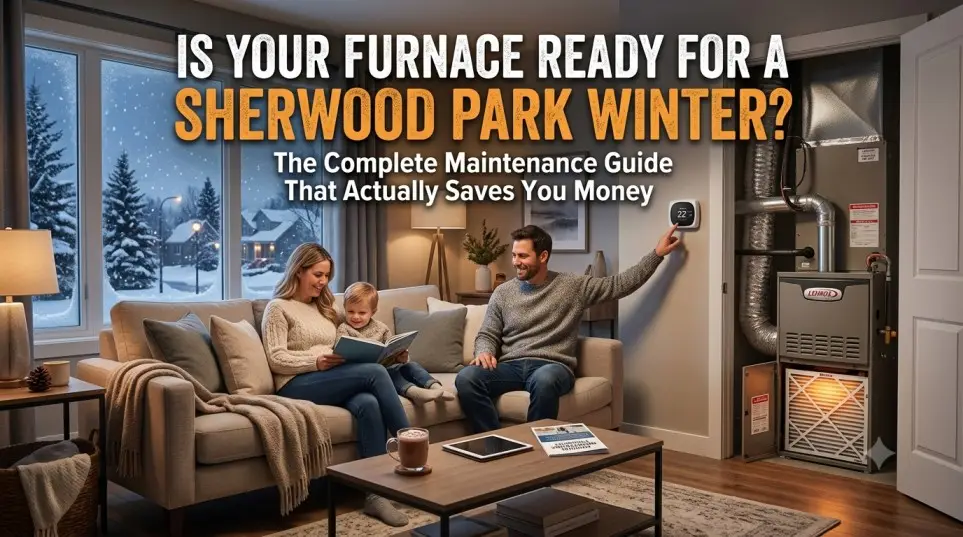
Is Your Furnace Ready for a Sherwood Park Winter? The Complete Maintenance Guide That Actually Saves You Money Here is the question most Sherwood Park homeowners never ask until it is too late: what does it actually cost to skip furnace maintenance — not in vague terms like “it could break down,” but in real dollars? A furnace that goes unmaintained in Sherwood Park’s climate runs 20–30% less efficiently within two to three seasons of neglect. That translates to $300–$500 per heating season in extra gas costs for a mid-sized home. Over five years of skipped tune-ups: $1,500–$2,500 in unnecessary gas spending, plus the near-certainty of at least one emergency repair call averaging $400–$700, plus a furnace that reaches end-of-life three to five years ahead of schedule — shaving thousands off the system’s value. Compare that to the cost of an annual furnace tune-up: typically $150–$250 in Sherwood Park. This guide covers everything a Sherwood Park homeowner needs to know before winter arrives — including what -30°C actually does to your furnace mechanically, what the homeowner checklist looks like, what a professional service visit should cover, and the five questions you should ask every HVAC technician before they leave. Featured Answer: What Does Furnace Maintenance Include in Sherwood Park? A professional furnace tune-up in Sherwood Park covers 12 to 22 inspection and service points: heat exchanger inspection for cracks, burner cleaning and combustion test, igniter resistance measurement, gas valve pressure verification, blower motor and capacitor inspection, flue system check, filter replacement, electrical connection tightening, thermostat calibration, safety control testing, and carbon monoxide detection. The entire visit takes 60 to 90 minutes and should be completed every year in September or early October — before the heating season begins. What -30°C Actually Does to Your Furnace: The Mechanics Nobody Explains Most furnace maintenance guides tell you to “get your furnace checked before winter.” They don’t explain why January specifically — rather than November or March — is when most Sherwood Park furnace failures happen. The answer is thermal stress. When outdoor temperatures drop to -30°C, your furnace runs longer cycles to maintain indoor temperature. In a typical Sherwood Park home set to 21°C, the temperature differential between inside and outside approaches 50 degrees — one of the largest heating loads your furnace ever faces. Every component in the system is working at or near maximum demand simultaneously. What happens to specific components at extreme cold: The heat exchanger undergoes repeated thermal expansion and contraction during each heating cycle — expanding as it heats to 500–600°F, contracting as it cools between cycles. Over thousands of cycles across a 15-year lifespan, this produces metal fatigue. A heat exchanger that was marginally intact in October can develop a crack under January’s sustained thermal demand. A cracked heat exchanger allows carbon monoxide — colourless, odourless, lethal at high concentrations — to enter the air circulating through your home. This is not a theoretical risk. It is the most serious safety finding a furnace technician can make, and it is found most often in aging systems that have never had an annual inspection. The igniter is the component that lights the burner when the thermostat calls for heat. Hot surface igniters — the most common type in modern Sherwood Park furnaces — degrade over time, their resistance changing as the ceramic element ages. An igniter that lights reliably in September may fail in January when demand is highest and temperatures are lowest. The specific failure pattern is almost never a dramatic complete failure — it is a gradual resistance increase that eventually crosses the threshold where the igniter can no longer reliably produce a flame. A professional tune-up measures igniter resistance and flags igniters approaching the failure range before they cause a no-heat call. The blower motor moves heated air through your ductwork. At peak demand in January, the blower runs nearly continuously. A capacitor that is weakening — producing reduced starting torque for the motor — may not show obvious symptoms in October but can fail under sustained January demand, leaving the system with heat in the heat exchanger but no means to distribute it. Capacitor replacement during a tune-up costs $80–$150. A no-heat service call because the capacitor failed mid-winter in Sherwood Park, including after-hours dispatch, typically costs $300–$600 for the same repair. The Real Cost Breakdown: Maintenance vs. Neglect Over 5 Years This is the calculation no competitor has done for Sherwood Park homeowners, and it is the most useful number in this entire guide. Scenario Year 1 Year 2 Year 3 Year 4 Year 5 Total Annual tune-up ($200/year) $200 $200 $200 $200 $200 $1,000 Gas savings from maintained efficiency (est. $300/yr) -$300 -$300 -$300 -$300 -$300 -$1,500 Net cost of maintenance -$500 (net savings) No maintenance $0 $0 $0 $0 $0 $0 spent Extra gas cost from reduced efficiency (est. $300/yr) +$300 +$300 +$300 +$300 +$300 +$1,500 Emergency repair (average 1 per 5 years without maintenance) — — $550 — — +$550 Early replacement (2–3 years early, est. $4,000 replacement) — — — — $4,000 +$4,000 Total cost of neglect +$6,050 The five-year difference between maintaining and not maintaining a Sherwood Park furnace is approximately $6,050 in real costs. These are conservative estimates. The actual numbers depend on your specific system, current gas prices, and whether the early replacement scenario applies. But the directional reality is consistent: annual furnace maintenance in Sherwood Park is not an expense. It is one of the highest-return maintenance investments available to a homeowner in Alberta’s climate. Homeowner Checklist: What You Can Do Before Booking a Professional Before calling for a professional tune-up, complete these six homeowner tasks. They take 30 minutes, cost nothing, and either resolve minor issues immediately or give the technician a head start on what to look for. 1. Replace the furnace filter Check the current filter — pull it out and hold it up to a light source. If you
Emergency HVAC Repair in Sherwood Park: What to Do, What Not to Do, and How to Be Ready Before It Happens
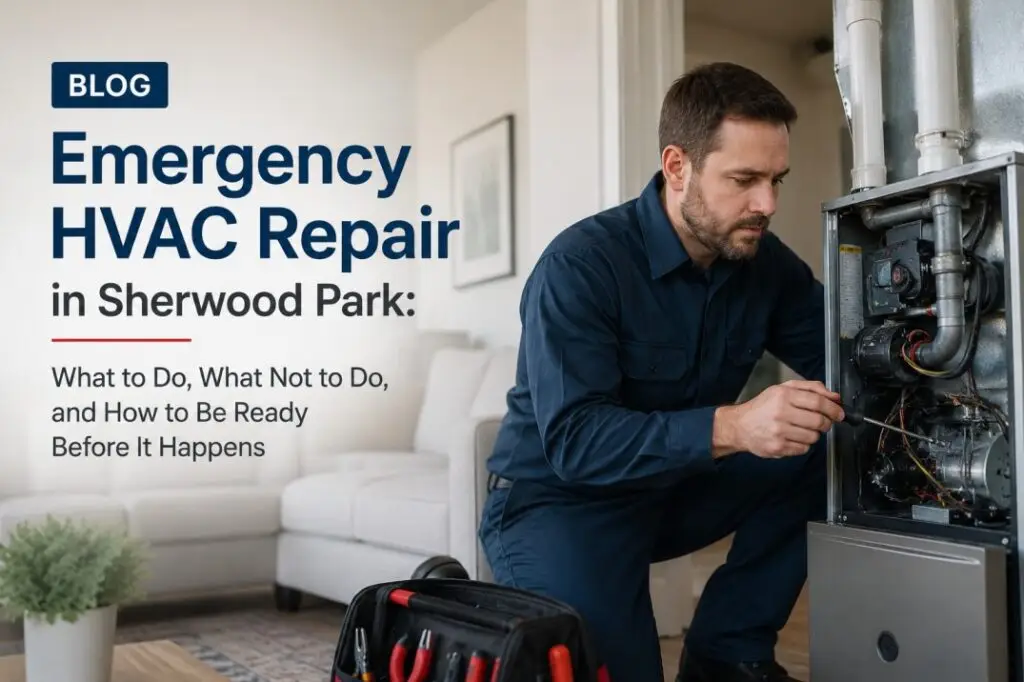
Emergency HVAC Repair in Sherwood Park: What to Do, What Not to Do, and How to Be Ready Before It Happens HVAC emergencies in Sherwood Park follow a consistent and frustrating pattern: they happen at the worst possible time. A furnace that fails at 11pm on a Wednesday in January when the temperature is -28°C. An air conditioner that stops cooling during the hottest week of July. A hot water tank that begins leaking into the utility room on a Saturday morning. None of these are predictable. But how prepared you are when they happen — what information you have on hand, what steps you take immediately, and what service team you call — determines whether the next few hours are managed or chaotic. This guide covers what to do in each type of HVAC emergency, what not to do (which matters just as much), and how to prepare before an emergency happens rather than during one. Furnace Emergency: No Heat in Sherwood Park Winter A furnace that stops heating in a Sherwood Park winter is not just uncomfortable — temperatures inside an unheated home in January can drop to dangerous levels within hours, particularly for young children, older adults, or anyone with a health condition. Step 1: Check the basics before calling a technician A significant number of no-heat calls turn out to have straightforward causes a homeowner can address without waiting for a service visit: Check the thermostat. Confirm it is set to heat mode, the setpoint is above the current room temperature, and batteries in a battery-powered thermostat are not dead. A thermostat accidentally switched to cooling or fan-only mode is one of the most common causes of apparent furnace failure. Check the furnace filter. A severely clogged filter causes the furnace to overheat and shut down on its high-limit safety switch. If the filter is visibly packed solid, replace it and reset the furnace by turning the power switch off and back on. This is one of the most preventable emergency causes — our guide on how long a furnace lasts in Sherwood Park covers how filter habits directly affect system reliability and lifespan. Check the circuit breaker. Furnace blower motors have dedicated circuits. A tripped breaker — often caused by a power surge or a motor that briefly overloaded — shuts the furnace down. Reset the breaker once. If it trips again immediately, do not reset it a second time — call a technician. Check the gas supply. If your gas range and hot water tank are also not working, the issue may be the gas supply rather than the furnace. Contact ATCO Gas if you suspect a supply interruption. Step 2: If the basics don’t resolve it, call for emergency service Sherwood Mechanical Services provides 24/7 emergency furnace repair in Sherwood Park — licensed technicians dispatched to your address as quickly as possible. Call (587) 853-5347. While waiting for the technician: Close off unused rooms to concentrate remaining heat in the spaces where people are present Use electric space heaters — one per circuit, never left unattended, never near combustibles Do not use a gas range, barbecue, or any other combustion appliance for supplemental heat indoors — this is a carbon monoxide risk If indoor temperatures drop below 15°C with vulnerable household members present, arrange alternative accommodation What not to do: Do not attempt to bypass safety switches or override the control board to force the furnace to run. Safety switches exist for critical reasons — a furnace shutting down on a high-limit switch is protecting against a cracked heat exchanger or a fire risk. Running through a safety shutoff can cause secondary damage or create a dangerous condition. Hot Water Tank Emergency: Active Leak or Complete Failure A hot water tank that is actively leaking onto the utility room floor needs to be shut down immediately. Water damage to flooring, subfloor, and stored items accumulates quickly, and a leaking tank body can fail completely and release its entire volume. Step 3: Shut down the system immediately Turn off the cold water supply valve on the cold water line entering the top of the tank (turn clockwise to close) Turn off the gas supply at the shutoff valve on the gas line near the unit (handle perpendicular to pipe = closed position) If significant water is on the floor near electrical outlets, shut off power to that area at the breaker panel before entering Step 4: Call for emergency service Our hot water tank repair team in Sherwood Park handles emergency diagnostics and same-day repair or replacement across Sherwood Park and Strathcona County. If the assessment reveals the tank has failed beyond repair, our hot water tank replacement service covers the full process from removal through to new unit installation and testing — and if a tankless water heater upgrade makes sense at this moment, that conversation can happen during the same visit. Our guide on tankless vs hot water tank is worth reading if you are facing an emergency replacement and want to evaluate both options before committing. If the tank has stopped producing hot water but is not actively leaking, this is urgent but not an immediate safety emergency. Call for service and note when the system last produced hot water and any unusual sounds in the days before failure. AC Emergency: System Failure During an Alberta Heat Wave A central air conditioner that stops cooling during a July heat wave in Sherwood Park is a genuine health concern for households with infants, elderly family members, or anyone with cardiac or respiratory conditions. Step 1: Check the basics Same sequence as a furnace emergency: thermostat mode, filter condition, circuit breaker. These three items resolve a meaningful proportion of apparent AC failures. Check for ice. An indoor coil that has frozen over will not cool the air regardless of whether the compressor is running. If you find ice on the refrigerant lines or indoor coil, switch to fan-only mode (no cooling) for
How Long Does a Furnace Last in Sherwood Park? An Honest Alberta Homeowner’s Guide
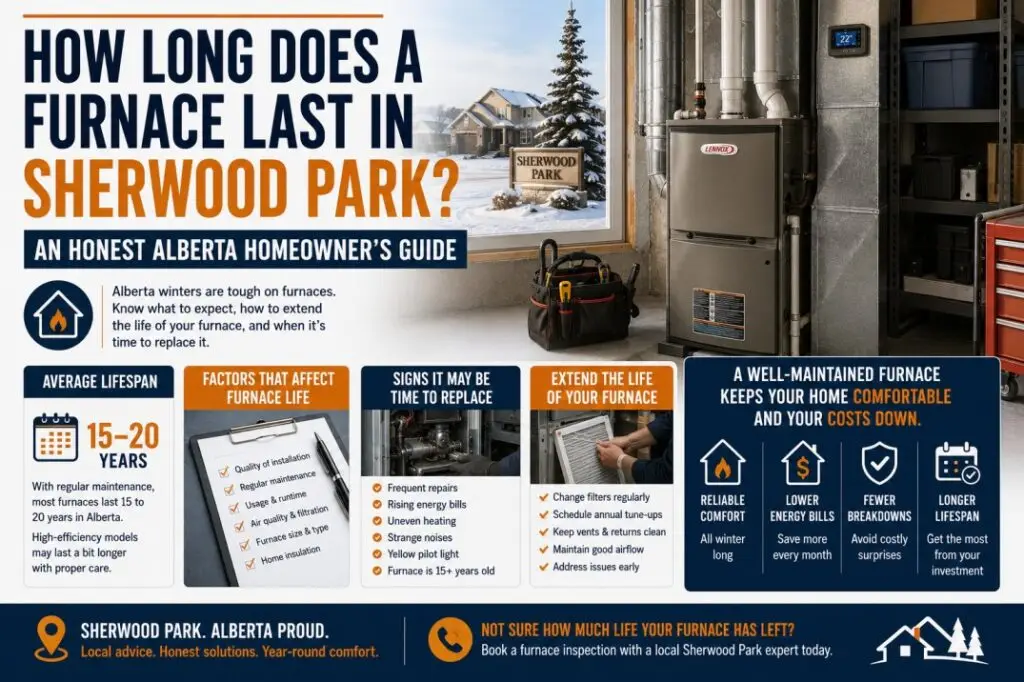
How Long Does a Furnace Last in Sherwood Park? An Honest Alberta Homeowner’s Guide If you have been wondering whether your furnace has a few more good winters left in it — or whether you are pushing your luck — you are asking exactly the right question. Furnace lifespan is one of the most frequently misunderstood topics in home maintenance. Manufacturer specifications say one thing, industry averages say another, and your technician’s answer during a service call can differ from both. The truth is that how long a furnace lasts depends less on the brand nameplate and more on a handful of factors that are almost entirely within the homeowner’s control. In Sherwood Park specifically, those factors carry extra weight — because Alberta’s heating seasons are longer, colder, and more demanding than most other parts of Canada. The Baseline: What the Numbers Actually Say A gas furnace in Alberta typically lasts between 15 and 20 years under normal operating conditions. That range assumes the system was correctly sized for the home, properly installed, and has received reasonably consistent maintenance over its lifespan. At the lower end of that range — 12 to 15 years — you find systems that were installed correctly but have received inconsistent maintenance: filter changes delayed, tune-ups skipped every few years, minor issues left unaddressed. The system still functions, but it has been working harder than it needed to, and the wear on key components reflects that. At the upper end — 18 to 22 years — you find systems that have been genuinely well looked after: annual professional tune-ups, consistent filter changes, prompt attention to any warning signs, and a clean installation environment. What you almost never find at the upper end of the lifespan range is a system that has been neglected. Why Sherwood Park Furnaces Work Harder Alberta’s heating season is one of the most demanding in Canada. In Sherwood Park, it is not unusual for overnight temperatures to sit below -20°C for extended periods, with the heating season running from October through April — and occasionally into May. That translates directly into operating hours. A furnace in Sherwood Park accumulates significantly more run time per year than the same unit installed in Vancouver or even Toronto. More run time means more wear on the blower motor, the heat exchanger, the igniter, and every other component that cycles with the system. This is why the national average lifespan figures — which are often calculated based on data from across all Canadian climates — should be treated as a starting point rather than a direct expectation for an Alberta home. A furnace running 2,400 hours per year in Sherwood Park is being asked to do considerably more than the same model running 1,000 hours in a milder city. It also explains why annual maintenance matters more here than in most other markets. The components are simply being asked to do more — and regular professional attention catches the early signs of wear before they become mid-winter failures. The 5 Factors That Most Affect Furnace Lifespan 1. Installation quality This is the factor that most homeowners don’t find out about until something goes wrong. A furnace that is incorrectly sized for the home — either too large or too small — will never perform efficiently and will experience accelerated component wear from the day it is installed. An oversized furnace short-cycles: it heats the space quickly, shuts off, cools down, fires back up, and repeats. Every startup is the most demanding moment in a furnace’s operating cycle — the igniter, the heat exchanger, and the gas valve all experience the most stress at ignition. A system that short-cycles five times per hour is accumulating five times the startup wear of a properly sized unit. An undersized furnace runs nearly continuously during cold snaps, which accumulates run-time hours far faster than normal operation, wearing out the blower motor and heat exchanger ahead of schedule. Proper sizing — calculated based on your home’s actual square footage, insulation level, window area, and layout — is what prevents both of these outcomes. 2. Filter maintenance This is the single most impactful thing a homeowner can do themselves to protect furnace lifespan — and the most frequently neglected. A clogged air filter restricts airflow through the system. When airflow is restricted, the furnace runs hotter than it should, the heat exchanger operates under greater thermal stress, and the blower motor works harder to move air through the system. Over months and years, this accelerates wear on every major component. In Sherwood Park, where furnaces run heavily from October through April, filters should be checked monthly during the heating season and replaced when visibly grey and dense — which in most homes means every one to three months. 3. Annual professional maintenance An annual tune-up by a licensed HVAC technician does things a homeowner simply cannot replicate with a filter change and a visual inspection: The heat exchanger is inspected for cracks — the most critical safety check, since a cracked heat exchanger can allow combustion gases including carbon monoxide to enter the living space The burner assembly is cleaned and the combustion process is verified The igniter is tested and its resistance measured — igniters typically show measurable decline before they fail Electrical connections are tightened and tested The blower motor and belt (where applicable) are inspected and lubricated The flue and exhaust system are checked for blockages The heat rise across the heat exchanger is measured to verify the system is operating within design specifications A furnace that is professionally maintained annually lives longer, runs more efficiently, and is far less likely to fail without warning. 4. The environment around the furnace Furnaces installed in cold, dusty, or poorly ventilated mechanical rooms perform worse and wear faster than those in clean, climate-appropriate spaces. Common issues in Sherwood Park homes include: Mechanical rooms that are too cold in winter, making the furnace work harder to maintain combustion conditions Inadequate