
Signs Your Air Conditioner Needs Replacing (Not Just Repairs)
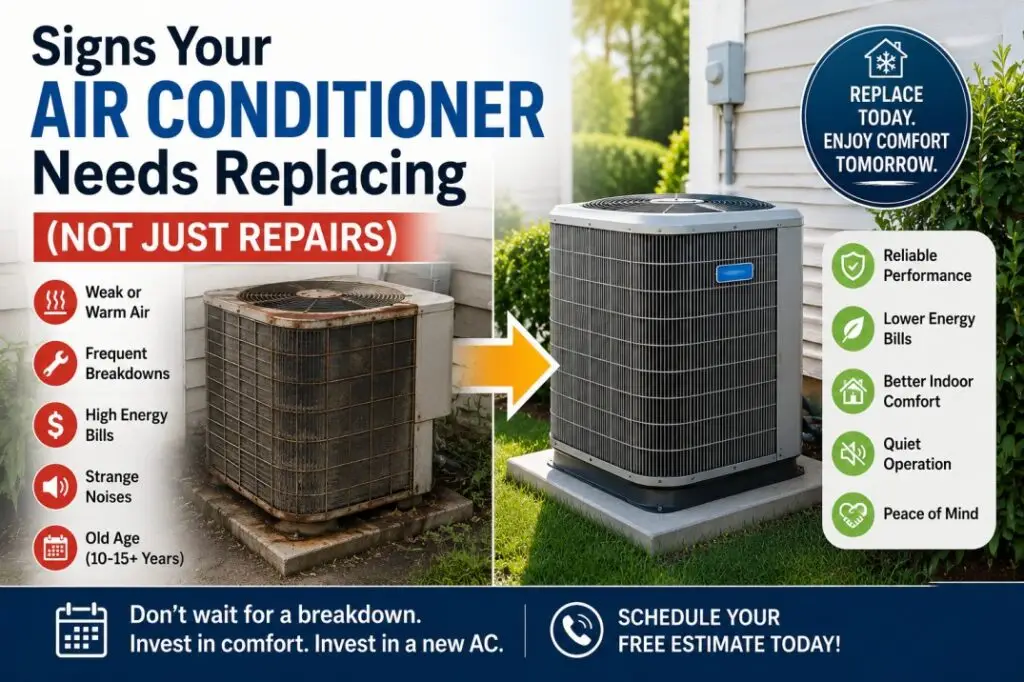
Signs Your Air Conditioner Needs Replacing (Not Just Repairs) When your air conditioner stops working the way it should, the first question is always the same: Is this something that can be fixed, or is it time for a new system? It’s not always an easy call. Repair costs are immediate and known. Replacement feels like a bigger commitment. But continuing to repair an AC system that has fundamentally reached the end of its useful life costs more in the long run — through repeated service calls, rising energy consumption, and the inevitable emergency failure on the hottest weekend of the summer. This guide walks you through the clearest signs that your air conditioner is telling you it’s ready to be replaced — so you can make an informed decision rather than an emotional one. How Long Should an Air Conditioner Last? Understanding the typical lifespan of an AC system is the starting point for any repair vs. replace decision. A well-maintained central air conditioner in Alberta typically lasts between 12 and 15 years. Systems that have been serviced consistently every year, with filters changed regularly and coils kept clean, tend to reach the upper end of that range. Systems that have been neglected — run without annual service, filters left unchanged for months, minor issues ignored — often begin to decline noticeably after 8 to 10 years. If your system is under 10 years old and experiencing problems, repair is almost always the right answer. If it’s over 10, the calculus shifts significantly toward replacement — particularly when multiple components are failing at the same time, or the type of refrigerant your system uses. 7 Signs Your AC Needs Replacing 1. The System Is Over 12 Years Old and Requires Frequent Repairs Age alone isn’t necessarily a reason to replace an AC — but age combined with a recent pattern of increasing repairs is a strong signal. If you’ve called for service two or three times in the past two summers, you’re likely approaching a tipping point where the compressor or another major component is next to go. When an older system starts requiring service repeatedly within a short window, the individual repairs may look manageable — but the cumulative spend adds up quickly. A licensed technician can give you an honest assessment of what the system’s major components look like and whether continued repair is a realistic strategy or a temporary delay of the inevitable. 2. Your Home Isn’t Cooling Evenly Anymore A well-functioning air conditioner maintains consistent temperatures throughout your home. When you start noticing that certain rooms never quite reach a comfortable temperature, or that there’s a significant difference between how the main floor and upper floor feel, the system may no longer have enough capacity to do its job. Uneven cooling can sometimes be addressed through ductwork adjustments or airflow balancing — but when it appears in an older system alongside other symptoms, it often signals that the system is losing its ability to perform at its rated capacity. Compressor wear, refrigerant issues, and degraded internal components all contribute to this gradual loss of performance. 3. The System Uses R-22 Refrigerant If your air conditioner was installed before 2010, there’s a good chance it uses R-22 refrigerant — a substance that has been phased out across Canada due to its environmental impact. R-22 is no longer manufactured, making it increasingly difficult and expensive to obtain. If your older system develops a refrigerant leak and requires a top-up, the unavailability of R-22 can make a repair impractical, regardless of the condition of other components. Ask your technician which refrigerant your system uses — if it’s R-22, that information should factor significantly into your replacement planning. 4. Your Energy Bills Have Increased Without Explanation Air conditioners lose efficiency as they age. Components wear, coils accumulate buildup, and the system has to run longer to achieve the same result it once reached easily. This gradual decline shows up on your energy bills — not as a sudden spike, but as a creeping increase that becomes noticeable when you compare this summer’s bills to bills from three or four summers ago. If your home’s usage patterns haven’t changed significantly but your energy consumption during cooling season has increased noticeably, your AC’s declining efficiency is a likely contributor. Modern systems are substantially more efficient than equipment from 10 to 15 years ago, and the efficiency gain from a new system can be significant over the long run. 5. The Compressor Is Failing The compressor is the heart of your air conditioning system — it’s the component that pressurizes the refrigerant and drives the entire cooling cycle. It is also the most expensive component in the system to replace. Signs of compressor trouble include hard starting (the system struggles to come on), the system running constantly without adequately cooling the home, loud clanking or rumbling sounds from the outdoor unit, or the system tripping the circuit breaker repeatedly. When a compressor fails on an older system, the repair estimate often approaches or exceeds the value of replacing the entire unit with a new, efficient system. If your technician tells you the compressor needs replacing on a system that’s already 10 years or older, replacement is almost always the more sensible long-term decision. 6. Refrigerant Leaks Keep Recurring Refrigerant doesn’t deplete under normal circumstances. If your system has needed refrigerant top-ups more than once, it has a leak — and if that leak keeps recurring after repairs, the integrity of the system’s refrigerant lines is compromised. Ongoing refrigerant loss damages the compressor, reduces cooling performance, and adds recurring service costs without resolving the underlying problem. A single refrigerant leak in a system that’s otherwise healthy and relatively young is typically worth repairing. Recurring leaks in an older system, or a leak in a difficult-to-access location within an aging unit, are strong indicators that a full air conditioning replacement is the more sound approach. 7. The System Makes Noises It Never Used
How Often Should You Service Your AC? A Sherwood Park Guide
How Often Should You Service Your AC? A Sherwood Park Guide It’s one of the most common questions homeowners ask: How often does my air conditioner actually need service? The honest answer is that most AC systems in Sherwood Park are serviced less often than they should be — and homeowners typically don’t realize it until something goes wrong. Understanding the right service schedule for your system isn’t just about preventing breakdowns. It’s about getting the longest possible life from a piece of equipment that works hard every summer and sits idle every winter. This guide covers exactly how often different types of AC service are needed, what each service involves, and the warning signs that tell you your system needs attention sooner than scheduled. The Short Answer: Once a Year, Every Year For the vast majority of residential air conditioning systems, one professional service per year is the standard recommendation — and that service should happen in spring, before you need your AC to perform. That single annual visit does more than most homeowners expect. A trained technician doesn’t just give the unit a quick look and move on. They measure refrigerant levels, test electrical components, clean coils, inspect the condensate drain, check capacitor readings, verify airflow, and make sure every part of the system is operating within the manufacturer’s specifications. Think of it the same way you think about servicing your vehicle. You wouldn’t skip an oil change for three years and expect the engine to perform flawlessly — the same logic applies to your air conditioner. What Affects How Often You Need AC Service? While once a year is the baseline for most homes, several factors can shift that recommendation: Age of the system. Air conditioners between 8 and 12 years old benefit from more frequent checks. As components age, the margin for error narrows, and small issues escalate faster. If your system is approaching the end of its expected lifespan, an inspection in both spring and fall gives you early warning before a failure occurs at the worst possible time. How hard does your system work? A home that runs the AC from May through September puts significantly more hours on the compressor and fan motors than a home that only runs it through July and August. High-use systems wear faster and benefit from more frequent attention. Pets and indoor air quality. Homes with multiple pets, heavy dust, or occupants with respiratory conditions cycle far more particulate through the system. Filters clog faster, and debris accumulates on coils more quickly. In these homes, checking the filter monthly and scheduling a mid-season inspection in addition to the annual service is a smart approach. The local environment. Sherwood Park’s spring brings cottonwood seeds and plant debris that pack into condenser fins with surprising speed. A quick outdoor unit inspection — and cleaning if needed — every spring is worthwhile before the first hot stretch arrives. Previous maintenance history. If the system hasn’t been professionally serviced in several years, one visit won’t fully catch up on everything that’s accumulated. A technician may recommend a follow-up inspection within the same season to confirm everything is stable after the initial cleaning and tune-up. The AC Service Schedule: A Practical Timeline Here’s a clear, season-by-season breakdown of what good AC maintenance looks like across the year: Spring (April – May) This is the most important service window of the year. Before the first warm stretch arrives: Book your annual professional AC maintenance Replace the air filter Clear debris from the outdoor condenser unit Test the thermostat in cooling mode to confirm it’s responsive Pour diluted vinegar through the condensate drain line to prevent algae buildup Summer (June – August) During active cooling season: Check the air filter monthly and replace it when it’s dirty Listen for any new or unusual sounds from the system Monitor whether the system is maintaining your set temperature consistently Treat the condensate drain line every 2–3 months If performance drops, call for service — don’t wait until the end of season Fall (September – October) As cooling season winds down: Change the air filter one final time before the furnace season begins Schedule a furnace maintenance if you haven’t done so — your HVAC technician can assess both systems in one visit Note any performance issues that developed during summer for your technician to assess in spring Winter (November – March) Your AC is dormant, but that doesn’t mean there’s nothing to do: If you notice ice, frost, or any moisture around the outdoor unit, have it checked — this is unusual in proper dormancy Keep the area around the outdoor unit clear of heavy snow accumulation to prevent structural damage to the unit What Happens During a Professional AC Service? Many homeowners aren’t entirely sure what a technician actually does during an AC service call — and understanding what’s included helps you know whether you’re getting genuine value or a surface-level visit. A thorough professional AC service from Sherwood Mechanical Services, Inc includes: Refrigerant check. Refrigerant doesn’t deplete on its own — if levels are low, there’s a leak somewhere. Your technician will check the charge and inspect for signs of refrigerant loss. Running a system low on refrigerant damages the compressor over time. Electrical component inspection. Capacitors, contactors, and wiring connections are all inspected and tested. Electrical failures are one of the most common causes of mid-season AC breakdowns, and they’re often preventable with early detection. Coil cleaning. The outdoor condenser coil is cleaned to remove the buildup that reduces heat transfer efficiency. Airflow measurement. Proper airflow is essential for efficient cooling. Your technician will verify that the blower motor is operating correctly and that air is moving through the system as designed. Condensate system inspection. The drain pan and drain line are checked to confirm they’re clear and draining properly, preventing water damage inside your home. Safety control testing. All safety shutoffs and controls are tested to confirm the system will respond correctly