
The Complete Annual HVAC Maintenance Guide for Sherwood Park Homeowners

The Complete Annual HVAC Maintenance Guide for Sherwood Park Homeowners Most Sherwood Park homeowners know their HVAC systems need maintenance. Fewer have a clear picture of what that maintenance actually involves, when each task should happen, and which items require a professional versus which can be handled independently between service visits. This guide provides a complete seasonal maintenance calendar for the heating, cooling, and water heating systems in a typical Sherwood Park home — organised by season, with clear distinction between homeowner tasks and professional service items. For a focused look at any individual system, the following guides go deeper on their specific topics: how long a furnace lasts in Sherwood Park · hot water tank maintenance guide · AC maintenance checklist for homeowners · how often to service your AC in Sherwood Park. Why Consistent HVAC Maintenance Matters More in Sherwood Park Alberta’s extreme seasonal swings put residential HVAC equipment under demands that most national maintenance guides underestimate. A furnace in Sherwood Park runs from October through April — accumulating significantly more annual operating hours than a furnace in Vancouver or Toronto. An air conditioner needs to perform reliably from the moment summer arrives with no warm-up period. Systems that are consistently maintained respond better to seasonal transitions, catch developing faults before they cause failures, and last measurably longer than those serviced reactively. In a climate where a mid-winter furnace failure or a July AC breakdown carry genuine consequences, the case for proactive maintenance is stronger here than in most other Canadian markets. Spring (April – May): Cooling System Prep and Heating Wind-Down Spring is the most important maintenance window for cooling systems — and the most commonly skipped. Homeowner tasks: Replace the furnace and air handler filter before cooling season begins. A fresh filter at the start of AC season ensures the system starts clean. Clear debris from the outdoor condenser unit. Sherwood Park’s cottonwood season is severe — check the condenser fins for packed seeds and rinse gently from inside out with a garden hose (never a pressure washer). Our full AC check-up guide for homeowners covers the complete outdoor unit cleaning process in detail. Clear at least 60cm of space around the entire condenser unit perimeter. Treat the condensate drain line with diluted vinegar to prevent algae buildup before cooling season. Test the thermostat in cooling mode — set below room temperature and confirm the system starts within a few minutes. Professional service: Book your annual air conditioning maintenance in Sherwood Park in April or May — before the first heat wave and before summer schedules fill. A comprehensive AC service includes refrigerant check, coil cleaning, electrical component testing, airflow measurement, and condensate system inspection. If you have a whole-home humidifier, spring is when it should be properly shut down for the season — water supply closed, bypass damper closed on bypass models, and the water panel left dry to prevent mould through summer. Our furnace humidifier repair and service guide covers the correct seasonal shutdown procedure for each humidifier type. If you have a boiler system rather than forced-air heating, spring is also a good window for post-season inspection before the system sits dormant through summer. Summer (June – August): Active Cooling Season Monitoring During active cooling season, consistent monitoring is the goal rather than major service intervention — catching small issues before they develop during the hottest weeks. Homeowner tasks (monthly): Check the air filter every month. During peak cooling season in a home with pets or multiple occupants, monthly replacement is often appropriate. Listen for new or unusual sounds during operation. A system developing a rattle, grinding sound, or clicking in July is communicating something worth addressing before the heat peaks. Monitor whether the system is maintaining your set temperature. A system running continuously without achieving your setpoint warrants a service call. Treat the condensate drain line every two to three months. Check your air purifier filter condition if you have a whole-home system installed. Understanding summer air quality: summer introduces distinct indoor air quality challenges beyond what a filter change alone addresses — wildfire smoke, cottonwood pollen, and humidity fluctuations all affect indoor air in Sherwood Park in ways that your HVAC system is part of managing. Our summer indoor air quality guide for Sherwood Park covers the full picture. If you are experiencing heat pump issues during cooling season: a heat pump used for cooling in summer should be serviced on the same schedule as a standard air conditioner. If performance drops, call for service rather than running through a fault. For context on heat pump maintenance requirements, our heat pump guide for Sherwood Park covers the annual service scope specific to heat pump systems. Fall (September – October): Furnace Prep — The Highest-Priority Service Window Fall is the most critical maintenance window for heating systems in Sherwood Park. The goal is to have every heating system inspected, serviced, and ready before the first significant cold snap — which can arrive as early as late September. Homeowner tasks: Replace the air filter at the start of heating season — a fresh filter going into the furnace’s peak operating months is one of the highest-impact single maintenance actions available to any homeowner. Check that furnace venting and flue terminations are clear of obstructions. Birds occasionally nest in exterior vent caps during summer. Test carbon monoxide detectors on every level and replace batteries. CO detectors themselves should be replaced every 5 to 7 years — check the manufacture date on yours today. Test the thermostat in heating mode before it is needed for sustained heating — a thermostat with dead batteries or a calibration drift discovered in November is a preventable disruption. Restart your whole-home humidifier for the heating season: open the water supply valve, open the bypass damper on bypass models, replace the water panel with a new one for the season, and set the humidistat for incoming weather conditions. Professional service: Book your annual furnace tune-up in Sherwood Park in
Signs Your Air Conditioner Needs Replacing (Not Just Repairs)
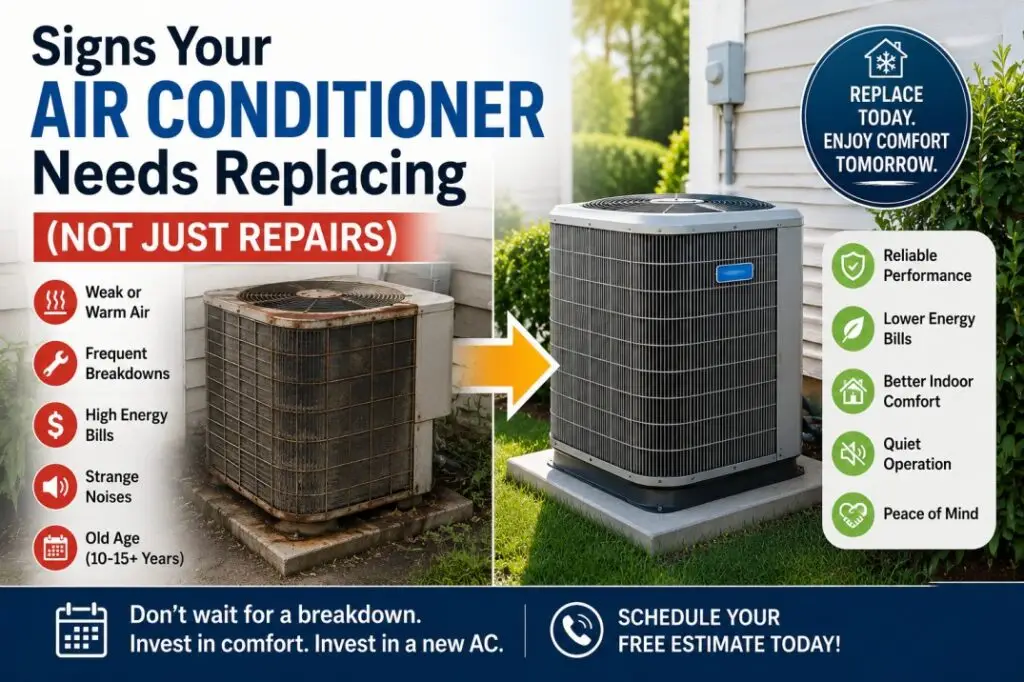
Signs Your Air Conditioner Needs Replacing (Not Just Repairs) When your air conditioner stops working the way it should, the first question is always the same: Is this something that can be fixed, or is it time for a new system? It’s not always an easy call. Repair costs are immediate and known. Replacement feels like a bigger commitment. But continuing to repair an AC system that has fundamentally reached the end of its useful life costs more in the long run — through repeated service calls, rising energy consumption, and the inevitable emergency failure on the hottest weekend of the summer. This guide walks you through the clearest signs that your air conditioner is telling you it’s ready to be replaced — so you can make an informed decision rather than an emotional one. How Long Should an Air Conditioner Last? Understanding the typical lifespan of an AC system is the starting point for any repair vs. replace decision. A well-maintained central air conditioner in Alberta typically lasts between 12 and 15 years. Systems that have been serviced consistently every year, with filters changed regularly and coils kept clean, tend to reach the upper end of that range. Systems that have been neglected — run without annual service, filters left unchanged for months, minor issues ignored — often begin to decline noticeably after 8 to 10 years. If your system is under 10 years old and experiencing problems, repair is almost always the right answer. If it’s over 10, the calculus shifts significantly toward replacement — particularly when multiple components are failing at the same time, or the type of refrigerant your system uses. 7 Signs Your AC Needs Replacing 1. The System Is Over 12 Years Old and Requires Frequent Repairs Age alone isn’t necessarily a reason to replace an AC — but age combined with a recent pattern of increasing repairs is a strong signal. If you’ve called for service two or three times in the past two summers, you’re likely approaching a tipping point where the compressor or another major component is next to go. When an older system starts requiring service repeatedly within a short window, the individual repairs may look manageable — but the cumulative spend adds up quickly. A licensed technician can give you an honest assessment of what the system’s major components look like and whether continued repair is a realistic strategy or a temporary delay of the inevitable. 2. Your Home Isn’t Cooling Evenly Anymore A well-functioning air conditioner maintains consistent temperatures throughout your home. When you start noticing that certain rooms never quite reach a comfortable temperature, or that there’s a significant difference between how the main floor and upper floor feel, the system may no longer have enough capacity to do its job. Uneven cooling can sometimes be addressed through ductwork adjustments or airflow balancing — but when it appears in an older system alongside other symptoms, it often signals that the system is losing its ability to perform at its rated capacity. Compressor wear, refrigerant issues, and degraded internal components all contribute to this gradual loss of performance. 3. The System Uses R-22 Refrigerant If your air conditioner was installed before 2010, there’s a good chance it uses R-22 refrigerant — a substance that has been phased out across Canada due to its environmental impact. R-22 is no longer manufactured, making it increasingly difficult and expensive to obtain. If your older system develops a refrigerant leak and requires a top-up, the unavailability of R-22 can make a repair impractical, regardless of the condition of other components. Ask your technician which refrigerant your system uses — if it’s R-22, that information should factor significantly into your replacement planning. 4. Your Energy Bills Have Increased Without Explanation Air conditioners lose efficiency as they age. Components wear, coils accumulate buildup, and the system has to run longer to achieve the same result it once reached easily. This gradual decline shows up on your energy bills — not as a sudden spike, but as a creeping increase that becomes noticeable when you compare this summer’s bills to bills from three or four summers ago. If your home’s usage patterns haven’t changed significantly but your energy consumption during cooling season has increased noticeably, your AC’s declining efficiency is a likely contributor. Modern systems are substantially more efficient than equipment from 10 to 15 years ago, and the efficiency gain from a new system can be significant over the long run. 5. The Compressor Is Failing The compressor is the heart of your air conditioning system — it’s the component that pressurizes the refrigerant and drives the entire cooling cycle. It is also the most expensive component in the system to replace. Signs of compressor trouble include hard starting (the system struggles to come on), the system running constantly without adequately cooling the home, loud clanking or rumbling sounds from the outdoor unit, or the system tripping the circuit breaker repeatedly. When a compressor fails on an older system, the repair estimate often approaches or exceeds the value of replacing the entire unit with a new, efficient system. If your technician tells you the compressor needs replacing on a system that’s already 10 years or older, replacement is almost always the more sensible long-term decision. 6. Refrigerant Leaks Keep Recurring Refrigerant doesn’t deplete under normal circumstances. If your system has needed refrigerant top-ups more than once, it has a leak — and if that leak keeps recurring after repairs, the integrity of the system’s refrigerant lines is compromised. Ongoing refrigerant loss damages the compressor, reduces cooling performance, and adds recurring service costs without resolving the underlying problem. A single refrigerant leak in a system that’s otherwise healthy and relatively young is typically worth repairing. Recurring leaks in an older system, or a leak in a difficult-to-access location within an aging unit, are strong indicators that a full air conditioning replacement is the more sound approach. 7. The System Makes Noises It Never Used