
How Long Does a Furnace Last in Sherwood Park? An Honest Alberta Homeowner’s Guide
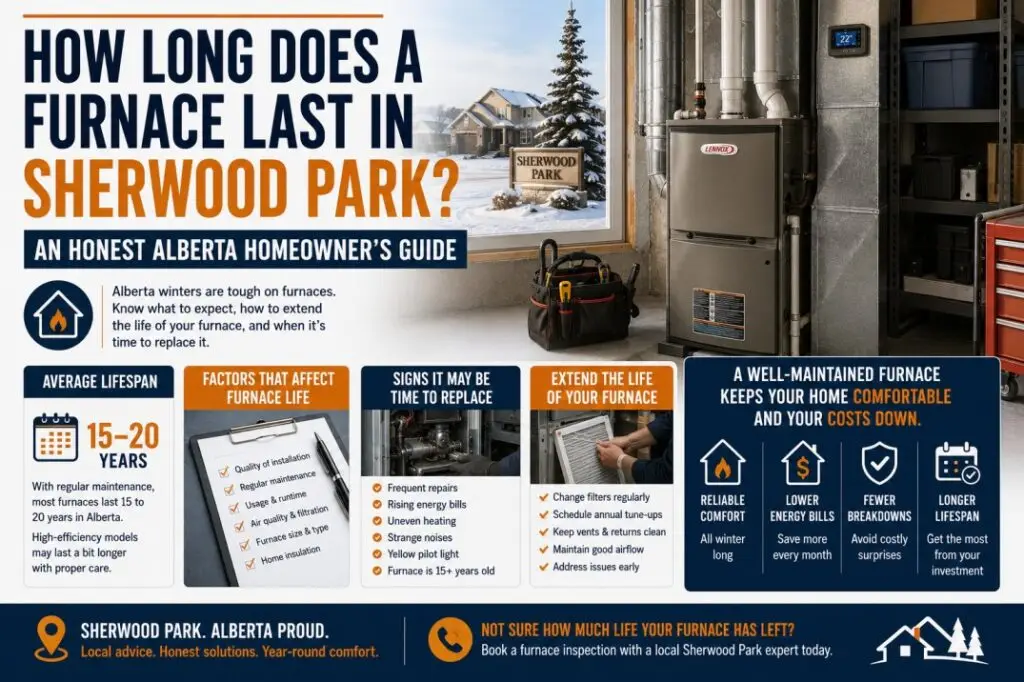
How Long Does a Furnace Last in Sherwood Park? An Honest Alberta Homeowner’s Guide If you have been wondering whether your furnace has a few more good winters left in it — or whether you are pushing your luck — you are asking exactly the right question. Furnace lifespan is one of the most frequently misunderstood topics in home maintenance. Manufacturer specifications say one thing, industry averages say another, and your technician’s answer during a service call can differ from both. The truth is that how long a furnace lasts depends less on the brand nameplate and more on a handful of factors that are almost entirely within the homeowner’s control. In Sherwood Park specifically, those factors carry extra weight — because Alberta’s heating seasons are longer, colder, and more demanding than most other parts of Canada. The Baseline: What the Numbers Actually Say A gas furnace in Alberta typically lasts between 15 and 20 years under normal operating conditions. That range assumes the system was correctly sized for the home, properly installed, and has received reasonably consistent maintenance over its lifespan. At the lower end of that range — 12 to 15 years — you find systems that were installed correctly but have received inconsistent maintenance: filter changes delayed, tune-ups skipped every few years, minor issues left unaddressed. The system still functions, but it has been working harder than it needed to, and the wear on key components reflects that. At the upper end — 18 to 22 years — you find systems that have been genuinely well looked after: annual professional tune-ups, consistent filter changes, prompt attention to any warning signs, and a clean installation environment. What you almost never find at the upper end of the lifespan range is a system that has been neglected. Why Sherwood Park Furnaces Work Harder Alberta’s heating season is one of the most demanding in Canada. In Sherwood Park, it is not unusual for overnight temperatures to sit below -20°C for extended periods, with the heating season running from October through April — and occasionally into May. That translates directly into operating hours. A furnace in Sherwood Park accumulates significantly more run time per year than the same unit installed in Vancouver or even Toronto. More run time means more wear on the blower motor, the heat exchanger, the igniter, and every other component that cycles with the system. This is why the national average lifespan figures — which are often calculated based on data from across all Canadian climates — should be treated as a starting point rather than a direct expectation for an Alberta home. A furnace running 2,400 hours per year in Sherwood Park is being asked to do considerably more than the same model running 1,000 hours in a milder city. It also explains why annual maintenance matters more here than in most other markets. The components are simply being asked to do more — and regular professional attention catches the early signs of wear before they become mid-winter failures. The 5 Factors That Most Affect Furnace Lifespan 1. Installation quality This is the factor that most homeowners don’t find out about until something goes wrong. A furnace that is incorrectly sized for the home — either too large or too small — will never perform efficiently and will experience accelerated component wear from the day it is installed. An oversized furnace short-cycles: it heats the space quickly, shuts off, cools down, fires back up, and repeats. Every startup is the most demanding moment in a furnace’s operating cycle — the igniter, the heat exchanger, and the gas valve all experience the most stress at ignition. A system that short-cycles five times per hour is accumulating five times the startup wear of a properly sized unit. An undersized furnace runs nearly continuously during cold snaps, which accumulates run-time hours far faster than normal operation, wearing out the blower motor and heat exchanger ahead of schedule. Proper sizing — calculated based on your home’s actual square footage, insulation level, window area, and layout — is what prevents both of these outcomes. 2. Filter maintenance This is the single most impactful thing a homeowner can do themselves to protect furnace lifespan — and the most frequently neglected. A clogged air filter restricts airflow through the system. When airflow is restricted, the furnace runs hotter than it should, the heat exchanger operates under greater thermal stress, and the blower motor works harder to move air through the system. Over months and years, this accelerates wear on every major component. In Sherwood Park, where furnaces run heavily from October through April, filters should be checked monthly during the heating season and replaced when visibly grey and dense — which in most homes means every one to three months. 3. Annual professional maintenance An annual tune-up by a licensed HVAC technician does things a homeowner simply cannot replicate with a filter change and a visual inspection: The heat exchanger is inspected for cracks — the most critical safety check, since a cracked heat exchanger can allow combustion gases including carbon monoxide to enter the living space The burner assembly is cleaned and the combustion process is verified The igniter is tested and its resistance measured — igniters typically show measurable decline before they fail Electrical connections are tightened and tested The blower motor and belt (where applicable) are inspected and lubricated The flue and exhaust system are checked for blockages The heat rise across the heat exchanger is measured to verify the system is operating within design specifications A furnace that is professionally maintained annually lives longer, runs more efficiently, and is far less likely to fail without warning. 4. The environment around the furnace Furnaces installed in cold, dusty, or poorly ventilated mechanical rooms perform worse and wear faster than those in clean, climate-appropriate spaces. Common issues in Sherwood Park homes include: Mechanical rooms that are too cold in winter, making the furnace work harder to maintain combustion conditions Inadequate