
Is Your Furnace Ready for a Sherwood Park Winter? The Complete Maintenance Guide That Actually Saves You Money

Is Your Furnace Ready for a Sherwood Park Winter? The Complete Maintenance Guide That Actually Saves You Money Here is the question most Sherwood Park homeowners never ask until it is too late: what does it actually cost to skip furnace maintenance — not in vague terms like “it could break down,” but in real dollars? A furnace that goes unmaintained in Sherwood Park’s climate runs 20–30% less efficiently within two to three seasons of neglect. That translates to $300–$500 per heating season in extra gas costs for a mid-sized home. Over five years of skipped tune-ups: $1,500–$2,500 in unnecessary gas spending, plus the near-certainty of at least one emergency repair call averaging $400–$700, plus a furnace that reaches end-of-life three to five years ahead of schedule — shaving thousands off the system’s value. Compare that to the cost of an annual furnace tune-up: typically $150–$250 in Sherwood Park. This guide covers everything a Sherwood Park homeowner needs to know before winter arrives — including what -30°C actually does to your furnace mechanically, what the homeowner checklist looks like, what a professional service visit should cover, and the five questions you should ask every HVAC technician before they leave. Featured Answer: What Does Furnace Maintenance Include in Sherwood Park? A professional furnace tune-up in Sherwood Park covers 12 to 22 inspection and service points: heat exchanger inspection for cracks, burner cleaning and combustion test, igniter resistance measurement, gas valve pressure verification, blower motor and capacitor inspection, flue system check, filter replacement, electrical connection tightening, thermostat calibration, safety control testing, and carbon monoxide detection. The entire visit takes 60 to 90 minutes and should be completed every year in September or early October — before the heating season begins. What -30°C Actually Does to Your Furnace: The Mechanics Nobody Explains Most furnace maintenance guides tell you to “get your furnace checked before winter.” They don’t explain why January specifically — rather than November or March — is when most Sherwood Park furnace failures happen. The answer is thermal stress. When outdoor temperatures drop to -30°C, your furnace runs longer cycles to maintain indoor temperature. In a typical Sherwood Park home set to 21°C, the temperature differential between inside and outside approaches 50 degrees — one of the largest heating loads your furnace ever faces. Every component in the system is working at or near maximum demand simultaneously. What happens to specific components at extreme cold: The heat exchanger undergoes repeated thermal expansion and contraction during each heating cycle — expanding as it heats to 500–600°F, contracting as it cools between cycles. Over thousands of cycles across a 15-year lifespan, this produces metal fatigue. A heat exchanger that was marginally intact in October can develop a crack under January’s sustained thermal demand. A cracked heat exchanger allows carbon monoxide — colourless, odourless, lethal at high concentrations — to enter the air circulating through your home. This is not a theoretical risk. It is the most serious safety finding a furnace technician can make, and it is found most often in aging systems that have never had an annual inspection. The igniter is the component that lights the burner when the thermostat calls for heat. Hot surface igniters — the most common type in modern Sherwood Park furnaces — degrade over time, their resistance changing as the ceramic element ages. An igniter that lights reliably in September may fail in January when demand is highest and temperatures are lowest. The specific failure pattern is almost never a dramatic complete failure — it is a gradual resistance increase that eventually crosses the threshold where the igniter can no longer reliably produce a flame. A professional tune-up measures igniter resistance and flags igniters approaching the failure range before they cause a no-heat call. The blower motor moves heated air through your ductwork. At peak demand in January, the blower runs nearly continuously. A capacitor that is weakening — producing reduced starting torque for the motor — may not show obvious symptoms in October but can fail under sustained January demand, leaving the system with heat in the heat exchanger but no means to distribute it. Capacitor replacement during a tune-up costs $80–$150. A no-heat service call because the capacitor failed mid-winter in Sherwood Park, including after-hours dispatch, typically costs $300–$600 for the same repair. The Real Cost Breakdown: Maintenance vs. Neglect Over 5 Years This is the calculation no competitor has done for Sherwood Park homeowners, and it is the most useful number in this entire guide. Scenario Year 1 Year 2 Year 3 Year 4 Year 5 Total Annual tune-up ($200/year) $200 $200 $200 $200 $200 $1,000 Gas savings from maintained efficiency (est. $300/yr) -$300 -$300 -$300 -$300 -$300 -$1,500 Net cost of maintenance -$500 (net savings) No maintenance $0 $0 $0 $0 $0 $0 spent Extra gas cost from reduced efficiency (est. $300/yr) +$300 +$300 +$300 +$300 +$300 +$1,500 Emergency repair (average 1 per 5 years without maintenance) — — $550 — — +$550 Early replacement (2–3 years early, est. $4,000 replacement) — — — — $4,000 +$4,000 Total cost of neglect +$6,050 The five-year difference between maintaining and not maintaining a Sherwood Park furnace is approximately $6,050 in real costs. These are conservative estimates. The actual numbers depend on your specific system, current gas prices, and whether the early replacement scenario applies. But the directional reality is consistent: annual furnace maintenance in Sherwood Park is not an expense. It is one of the highest-return maintenance investments available to a homeowner in Alberta’s climate. Homeowner Checklist: What You Can Do Before Booking a Professional Before calling for a professional tune-up, complete these six homeowner tasks. They take 30 minutes, cost nothing, and either resolve minor issues immediately or give the technician a head start on what to look for. 1. Replace the furnace filter Check the current filter — pull it out and hold it up to a light source. If you
The Complete Annual HVAC Maintenance Guide for Sherwood Park Homeowners
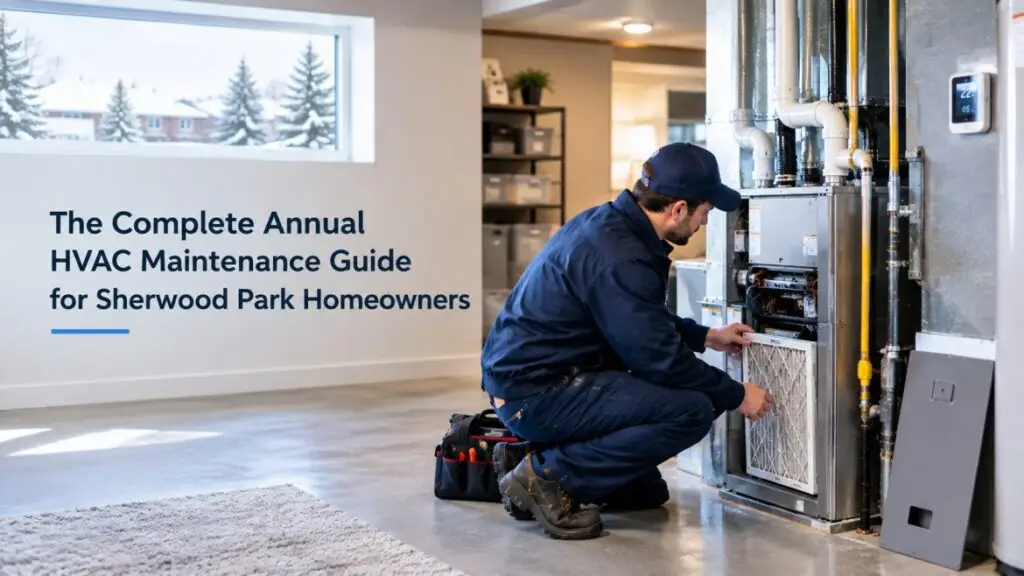
The Complete Annual HVAC Maintenance Guide for Sherwood Park Homeowners Most Sherwood Park homeowners know their HVAC systems need maintenance. Fewer have a clear picture of what that maintenance actually involves, when each task should happen, and which items require a professional versus which can be handled independently between service visits. This guide provides a complete seasonal maintenance calendar for the heating, cooling, and water heating systems in a typical Sherwood Park home — organised by season, with clear distinction between homeowner tasks and professional service items. For a focused look at any individual system, the following guides go deeper on their specific topics: how long a furnace lasts in Sherwood Park · hot water tank maintenance guide · AC maintenance checklist for homeowners · how often to service your AC in Sherwood Park. Why Consistent HVAC Maintenance Matters More in Sherwood Park Alberta’s extreme seasonal swings put residential HVAC equipment under demands that most national maintenance guides underestimate. A furnace in Sherwood Park runs from October through April — accumulating significantly more annual operating hours than a furnace in Vancouver or Toronto. An air conditioner needs to perform reliably from the moment summer arrives with no warm-up period. Systems that are consistently maintained respond better to seasonal transitions, catch developing faults before they cause failures, and last measurably longer than those serviced reactively. In a climate where a mid-winter furnace failure or a July AC breakdown carry genuine consequences, the case for proactive maintenance is stronger here than in most other Canadian markets. Spring (April – May): Cooling System Prep and Heating Wind-Down Spring is the most important maintenance window for cooling systems — and the most commonly skipped. Homeowner tasks: Replace the furnace and air handler filter before cooling season begins. A fresh filter at the start of AC season ensures the system starts clean. Clear debris from the outdoor condenser unit. Sherwood Park’s cottonwood season is severe — check the condenser fins for packed seeds and rinse gently from inside out with a garden hose (never a pressure washer). Our full AC check-up guide for homeowners covers the complete outdoor unit cleaning process in detail. Clear at least 60cm of space around the entire condenser unit perimeter. Treat the condensate drain line with diluted vinegar to prevent algae buildup before cooling season. Test the thermostat in cooling mode — set below room temperature and confirm the system starts within a few minutes. Professional service: Book your annual air conditioning maintenance in Sherwood Park in April or May — before the first heat wave and before summer schedules fill. A comprehensive AC service includes refrigerant check, coil cleaning, electrical component testing, airflow measurement, and condensate system inspection. If you have a whole-home humidifier, spring is when it should be properly shut down for the season — water supply closed, bypass damper closed on bypass models, and the water panel left dry to prevent mould through summer. Our furnace humidifier repair and service guide covers the correct seasonal shutdown procedure for each humidifier type. If you have a boiler system rather than forced-air heating, spring is also a good window for post-season inspection before the system sits dormant through summer. Summer (June – August): Active Cooling Season Monitoring During active cooling season, consistent monitoring is the goal rather than major service intervention — catching small issues before they develop during the hottest weeks. Homeowner tasks (monthly): Check the air filter every month. During peak cooling season in a home with pets or multiple occupants, monthly replacement is often appropriate. Listen for new or unusual sounds during operation. A system developing a rattle, grinding sound, or clicking in July is communicating something worth addressing before the heat peaks. Monitor whether the system is maintaining your set temperature. A system running continuously without achieving your setpoint warrants a service call. Treat the condensate drain line every two to three months. Check your air purifier filter condition if you have a whole-home system installed. Understanding summer air quality: summer introduces distinct indoor air quality challenges beyond what a filter change alone addresses — wildfire smoke, cottonwood pollen, and humidity fluctuations all affect indoor air in Sherwood Park in ways that your HVAC system is part of managing. Our summer indoor air quality guide for Sherwood Park covers the full picture. If you are experiencing heat pump issues during cooling season: a heat pump used for cooling in summer should be serviced on the same schedule as a standard air conditioner. If performance drops, call for service rather than running through a fault. For context on heat pump maintenance requirements, our heat pump guide for Sherwood Park covers the annual service scope specific to heat pump systems. Fall (September – October): Furnace Prep — The Highest-Priority Service Window Fall is the most critical maintenance window for heating systems in Sherwood Park. The goal is to have every heating system inspected, serviced, and ready before the first significant cold snap — which can arrive as early as late September. Homeowner tasks: Replace the air filter at the start of heating season — a fresh filter going into the furnace’s peak operating months is one of the highest-impact single maintenance actions available to any homeowner. Check that furnace venting and flue terminations are clear of obstructions. Birds occasionally nest in exterior vent caps during summer. Test carbon monoxide detectors on every level and replace batteries. CO detectors themselves should be replaced every 5 to 7 years — check the manufacture date on yours today. Test the thermostat in heating mode before it is needed for sustained heating — a thermostat with dead batteries or a calibration drift discovered in November is a preventable disruption. Restart your whole-home humidifier for the heating season: open the water supply valve, open the bypass damper on bypass models, replace the water panel with a new one for the season, and set the humidistat for incoming weather conditions. Professional service: Book your annual furnace tune-up in Sherwood Park in
How Long Does a Furnace Last in Sherwood Park? An Honest Alberta Homeowner’s Guide
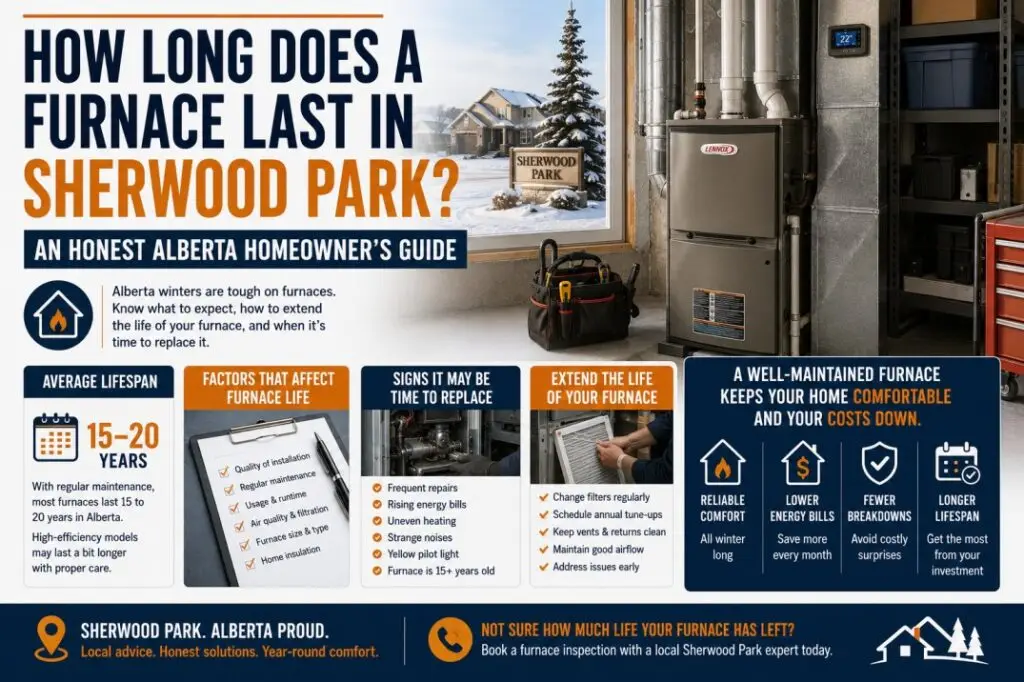
How Long Does a Furnace Last in Sherwood Park? An Honest Alberta Homeowner’s Guide If you have been wondering whether your furnace has a few more good winters left in it — or whether you are pushing your luck — you are asking exactly the right question. Furnace lifespan is one of the most frequently misunderstood topics in home maintenance. Manufacturer specifications say one thing, industry averages say another, and your technician’s answer during a service call can differ from both. The truth is that how long a furnace lasts depends less on the brand nameplate and more on a handful of factors that are almost entirely within the homeowner’s control. In Sherwood Park specifically, those factors carry extra weight — because Alberta’s heating seasons are longer, colder, and more demanding than most other parts of Canada. The Baseline: What the Numbers Actually Say A gas furnace in Alberta typically lasts between 15 and 20 years under normal operating conditions. That range assumes the system was correctly sized for the home, properly installed, and has received reasonably consistent maintenance over its lifespan. At the lower end of that range — 12 to 15 years — you find systems that were installed correctly but have received inconsistent maintenance: filter changes delayed, tune-ups skipped every few years, minor issues left unaddressed. The system still functions, but it has been working harder than it needed to, and the wear on key components reflects that. At the upper end — 18 to 22 years — you find systems that have been genuinely well looked after: annual professional tune-ups, consistent filter changes, prompt attention to any warning signs, and a clean installation environment. What you almost never find at the upper end of the lifespan range is a system that has been neglected. Why Sherwood Park Furnaces Work Harder Alberta’s heating season is one of the most demanding in Canada. In Sherwood Park, it is not unusual for overnight temperatures to sit below -20°C for extended periods, with the heating season running from October through April — and occasionally into May. That translates directly into operating hours. A furnace in Sherwood Park accumulates significantly more run time per year than the same unit installed in Vancouver or even Toronto. More run time means more wear on the blower motor, the heat exchanger, the igniter, and every other component that cycles with the system. This is why the national average lifespan figures — which are often calculated based on data from across all Canadian climates — should be treated as a starting point rather than a direct expectation for an Alberta home. A furnace running 2,400 hours per year in Sherwood Park is being asked to do considerably more than the same model running 1,000 hours in a milder city. It also explains why annual maintenance matters more here than in most other markets. The components are simply being asked to do more — and regular professional attention catches the early signs of wear before they become mid-winter failures. The 5 Factors That Most Affect Furnace Lifespan 1. Installation quality This is the factor that most homeowners don’t find out about until something goes wrong. A furnace that is incorrectly sized for the home — either too large or too small — will never perform efficiently and will experience accelerated component wear from the day it is installed. An oversized furnace short-cycles: it heats the space quickly, shuts off, cools down, fires back up, and repeats. Every startup is the most demanding moment in a furnace’s operating cycle — the igniter, the heat exchanger, and the gas valve all experience the most stress at ignition. A system that short-cycles five times per hour is accumulating five times the startup wear of a properly sized unit. An undersized furnace runs nearly continuously during cold snaps, which accumulates run-time hours far faster than normal operation, wearing out the blower motor and heat exchanger ahead of schedule. Proper sizing — calculated based on your home’s actual square footage, insulation level, window area, and layout — is what prevents both of these outcomes. 2. Filter maintenance This is the single most impactful thing a homeowner can do themselves to protect furnace lifespan — and the most frequently neglected. A clogged air filter restricts airflow through the system. When airflow is restricted, the furnace runs hotter than it should, the heat exchanger operates under greater thermal stress, and the blower motor works harder to move air through the system. Over months and years, this accelerates wear on every major component. In Sherwood Park, where furnaces run heavily from October through April, filters should be checked monthly during the heating season and replaced when visibly grey and dense — which in most homes means every one to three months. 3. Annual professional maintenance An annual tune-up by a licensed HVAC technician does things a homeowner simply cannot replicate with a filter change and a visual inspection: The heat exchanger is inspected for cracks — the most critical safety check, since a cracked heat exchanger can allow combustion gases including carbon monoxide to enter the living space The burner assembly is cleaned and the combustion process is verified The igniter is tested and its resistance measured — igniters typically show measurable decline before they fail Electrical connections are tightened and tested The blower motor and belt (where applicable) are inspected and lubricated The flue and exhaust system are checked for blockages The heat rise across the heat exchanger is measured to verify the system is operating within design specifications A furnace that is professionally maintained annually lives longer, runs more efficiently, and is far less likely to fail without warning. 4. The environment around the furnace Furnaces installed in cold, dusty, or poorly ventilated mechanical rooms perform worse and wear faster than those in clean, climate-appropriate spaces. Common issues in Sherwood Park homes include: Mechanical rooms that are too cold in winter, making the furnace work harder to maintain combustion conditions Inadequate