
Summer Indoor Air Quality in Sherwood Park: What’s Happening Inside Your Home and How to Fix It

Summer Indoor Air Quality in Sherwood Park: What’s Happening Inside Your Home and How to Fix It Most homeowners think about indoor air quality in winter — dry furnace air, static electricity, stuffy rooms. Summer feels different: windows open, fresh air available, the house breathing more easily. The reality is more complicated. Summer in Sherwood Park introduces a distinct set of indoor air quality challenges that most homeowners are not thinking about, and some of them are actually worse than anything the heating season produces. This guide walks through what actually happens to the air inside your home during summer, what the common symptoms are, and what the practical solutions look like. Why Summer Air Quality Is Different — Not Better Wildfire smoke and outdoor particulate Alberta summers increasingly bring smoke from wildfires across western Canada. During smoke events, the outdoor air quality in Sherwood Park can drop dramatically, and simply opening windows — the instinctive summer solution to stuffy air — pulls that particulate directly into your home. Fine particulate matter from wildfire smoke (PM2.5) is small enough to penetrate deep into the lungs and is associated with respiratory irritation, worsened asthma symptoms, cardiovascular stress, and other health effects. During a smoke event, a home without any air filtration or purification is simply full of outdoor air — including everything in it. Cottonwood season and pollen Sherwood Park’s spring and early summer cottonwood season is notorious for its intensity, and the pollen and airborne particles it produces don’t stay outside. Standard HVAC filters catch some of this material, but lower-MERV filters (the basic fibreglass type found in many homes) allow a significant portion of fine pollen and allergen particles to pass through and circulate throughout the home. For households with allergy sufferers or anyone with respiratory sensitivities, this is a meaningful seasonal problem that air filtration can substantially reduce. Humidity and biological growth Summer brings higher outdoor humidity, and in a home where the air conditioning is running regularly, the humidity level inside fluctuates as the system cycles on and off. When the AC is running, it dehumidifies the air as a byproduct of cooling. When it cycles off, humidity begins to recover. In areas of the home that don’t receive conditioned air uniformly — basements, crawlspaces, poorly ventilated closets, areas behind large furniture — humidity can remain elevated enough during summer to support mould and bacterial growth. The resulting spores and volatile organic compounds (VOCs) then circulate through the home via the HVAC system. VOCs from summer activities Summer home improvement projects, painting, cleaning, and new furniture or flooring all release volatile organic compounds into the indoor environment. VOCs are a broad category of airborne chemicals that includes everything from paint solvents to formaldehyde off-gassing from engineered wood products. At sufficient concentrations, they cause headaches, eye and throat irritation, and — with chronic exposure — more serious health effects. The combination of warmer temperatures (which accelerates off-gassing) and tighter house construction (which reduces natural air exchange) means VOC concentrations can be higher in summer than at other times of the year, particularly in newer or recently renovated homes. What Good Summer Indoor Air Quality Looks Like Filtration: The first line of defence Your furnace filter is also your air conditioner’s filter — the same filter is in the airstream whenever the system is circulating air, whether for cooling or heating. During summer when the AC is running, that filter is actively catching whatever is circulating through the home. A MERV 8 filter (the standard pleated filter available at most hardware stores) catches particles down to about 3 microns — adequate for basic dust and pollen but not for wildfire smoke particulate or the finest allergens. A MERV 13 filter catches particles down to 0.3 microns, which includes wildfire smoke PM2.5, fine pollen, mould spores, and many bacteria. It is the minimum rating that provides meaningful protection during smoke events. One important caveat: higher-MERV filters restrict airflow more than lower-MERV filters. Not every HVAC system is designed to handle the additional resistance of a MERV 13 filter without affecting system performance or accelerating wear on the blower motor. Check with a licensed HVAC technician before upgrading your filter rating — or have a whole-home air filtration system installed that is properly matched to your system’s airflow capacity. Whole-home air purifiers: A permanent solution A whole-home air purifier integrates directly with your HVAC system and treats all of the air circulating through the home — not just the air in whatever room a portable unit happens to be sitting in. Modern whole-home air purification systems use a combination of high-efficiency filtration, UV-C light technology, and in some cases ionisation to neutralise airborne particles, allergens, mould spores, bacteria, and VOCs. Because they work in the main airstream, they treat the air in every room of the house every time the system circulates — which is a fundamentally different level of coverage than any portable unit can provide. For Sherwood Park homeowners dealing with seasonal allergies, households with young children or immunocompromised family members, or homes in areas affected by wildfire smoke, a whole-home air purifier is the most comprehensive available solution. Humidity management in summer Unlike winter, when dry furnace air makes whole-home humidifiers essential, summer humidity management is typically about control rather than addition. For most Sherwood Park homes, the air conditioning system handles enough dehumidification during cooling cycles to keep indoor humidity in a comfortable range. The areas to watch are those that the AC does not adequately reach: basements, crawlspaces, and rooms with limited airflow. If these areas feel persistently damp or develop a musty smell in summer, a targeted dehumidifier or an improvement to the HVAC airflow in those areas is worth investigating. If you do use a whole-home humidifier (which most Sherwood Park homes benefit from in winter), ensure it is set correctly for summer operation — or turned off entirely. Running a humidifier into summer when ambient humidity is already adequate can contribute
Garage Heater Guide for Sherwood Park Homeowners: Gas vs Electric, Sizing, and What to Expect
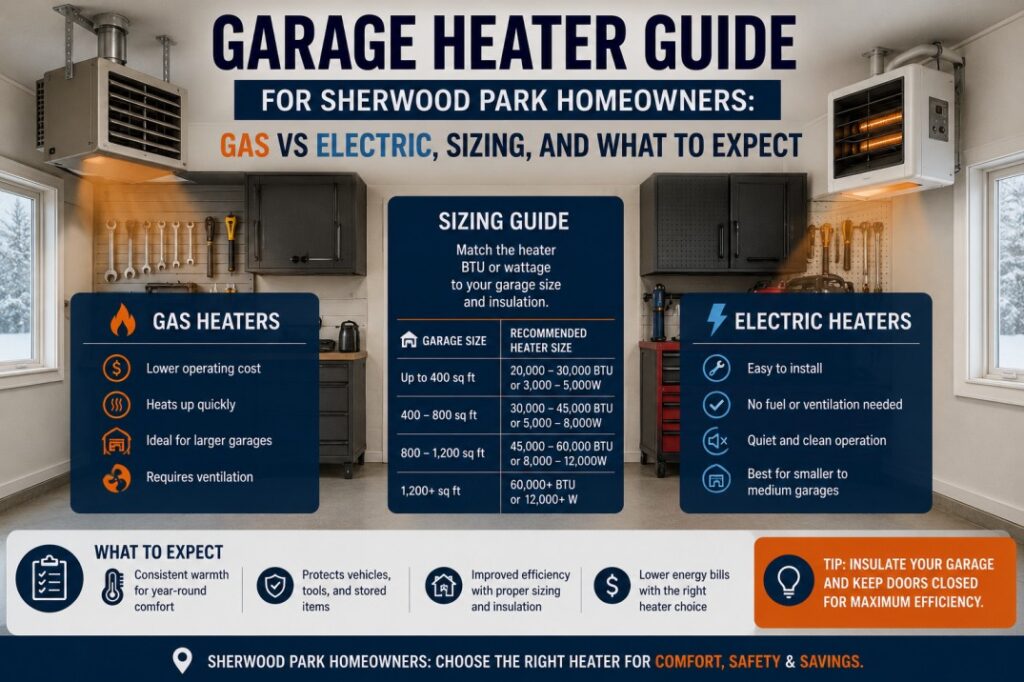
Garage Heater Guide for Sherwood Park Homeowners: Gas vs Electric, Sizing, and What to Expect In most of Canada, a heated garage is a convenience. In Sherwood Park — where January temperatures regularly drop below -20°C and wind chills push that further — it is closer to a necessity. Whether you are working in the space, protecting vehicles from the cold, running a small workshop, or simply trying to make sure your pipes don’t freeze, the right garage heater makes the difference between a usable space in winter and one that sits unused for five months of the year. This guide covers everything Sherwood Park homeowners need to know before installing a garage heater: the two main system types, how to determine the right size for your space, what the installation involves, and what to watch for if your existing heater is showing signs of trouble. Gas vs Electric: The Core Decision The first and most consequential decision in choosing a garage heater is fuel type. Both gas and electric heaters have genuine advantages, and the right choice depends on your garage’s existing infrastructure, how you plan to use the space, and how the garage is positioned relative to your home’s gas supply. Gas garage heaters use natural gas to produce heat through a burner assembly, distributing warmth either through a forced-air blower or through radiant infrared technology. They are the dominant choice for larger garages and workshops in Sherwood Park for several reasons: Heating capacity. Gas units are available in much higher BTU outputs than comparable electric heaters, making them capable of heating large two-car or three-car garages efficiently even in extreme cold. Operating characteristics. Gas heaters respond quickly — a forced-air unit reaches operating temperature within minutes and can meaningfully warm a large space in 15 to 20 minutes. Running costs. In Alberta, where natural gas rates have historically been lower than electricity rates, gas heaters are typically less expensive to operate over time for high-use applications. The trade-offs: gas heater installation requires a licensed gas fitter to run a gas line to the garage (if one doesn’t already exist), install proper venting for combustion gases, and ensure the installation meets Alberta Safety Codes. The upfront installation scope is larger than a comparable electric unit. Electric garage heaters use resistance heating elements — similar in principle to a large space heater — to warm the space. They are available in wall-mounted, ceiling-mounted, and portable configurations. Simpler installation. An electric heater installation requires a dedicated electrical circuit rather than gas line work and venting. In garages that already have adequate electrical service, this can be a significantly more straightforward project. Lower upfront scope. The installation does not require gas fitting work, which reduces both the complexity and the number of tradespeople involved. Better for smaller spaces. For a single-car garage used occasionally, an electric unit often provides sufficient heat without the infrastructure investment of a gas installation. The trade-offs: electric heaters are generally limited in the output they can deliver per unit compared to gas, and in Alberta’s climate, heating a large garage with electricity in January requires substantial electrical capacity and tends to carry higher operating costs than gas. Understanding BTUs: Sizing Your Heater for the Space A garage heater that is too small for the space will run continuously without ever making the garage genuinely comfortable. A heater that is oversized may be more capable than needed and wastes both equipment capacity and energy. Proper sizing requires calculating the heat loss of the space — how quickly the garage loses heat to the cold outside — which depends on: Floor area. The square footage of the garage is the starting point, but not the whole picture. Ceiling height. A garage with standard 8-foot ceilings has a smaller air volume to heat than one with a 12-foot ceiling. High-bay garages with vaulted ceilings require significantly more heating capacity than standard-height spaces of the same floor area. Insulation. An uninsulated garage loses heat dramatically faster than an insulated one. A typical uninsulated single-car garage in Sherwood Park may require two to three times the BTU output of a well-insulated equivalent to maintain the same interior temperature on a cold day. Door type and number. Garage doors are significant sources of heat loss, particularly older single-pane steel doors without insulation. Large bay doors in workshop settings are major factors in heat load calculations. Desired interior temperature. There is a meaningful difference between keeping a garage at 5°C (just above freezing, sufficient to protect pipes and vehicles) and maintaining it at 15–18°C (comfortable for working in coveralls). The target temperature affects the BTU requirement significantly. A rough industry guideline for basic estimation is 30 to 60 BTUs per cubic foot of space for an uninsulated Alberta garage. A licensed HVAC technician can calculate this accurately for your specific space. What the Installation Involves Gas heater installation in Sherwood Park requires: A gas line run to the heater location, sized for the unit’s BTU demand — this involves a licensed gas fitter A venting system appropriate for the heater type: forced-air units typically use a power-vent or direct-vent configuration; infrared radiant heaters typically use a direct flue to exterior Proper clearances from combustible materials, as specified by the manufacturer and Alberta Safety Codes Electrical connection for the thermostat, ignition, and blower (where applicable) A post-installation inspection and combustion test to verify safe operation Electric heater installation requires: A dedicated electrical circuit sized for the heater’s amperage draw, run from the main panel Proper mounting at the manufacturer’s specified height and clearances Thermostat wiring where the unit uses a separate thermostat rather than an integrated control Both types of installation should be completed by licensed tradespeople and inspected to Alberta safety code standards before use. Signs Your Existing Garage Heater Needs Attention If you already have a garage heater installed, these are the warning signs that it needs service: The unit ignites but shuts off shortly after starting. This is one of