
Heat Pumps in Sherwood Park: Do They Actually Work in Alberta’s Winters?
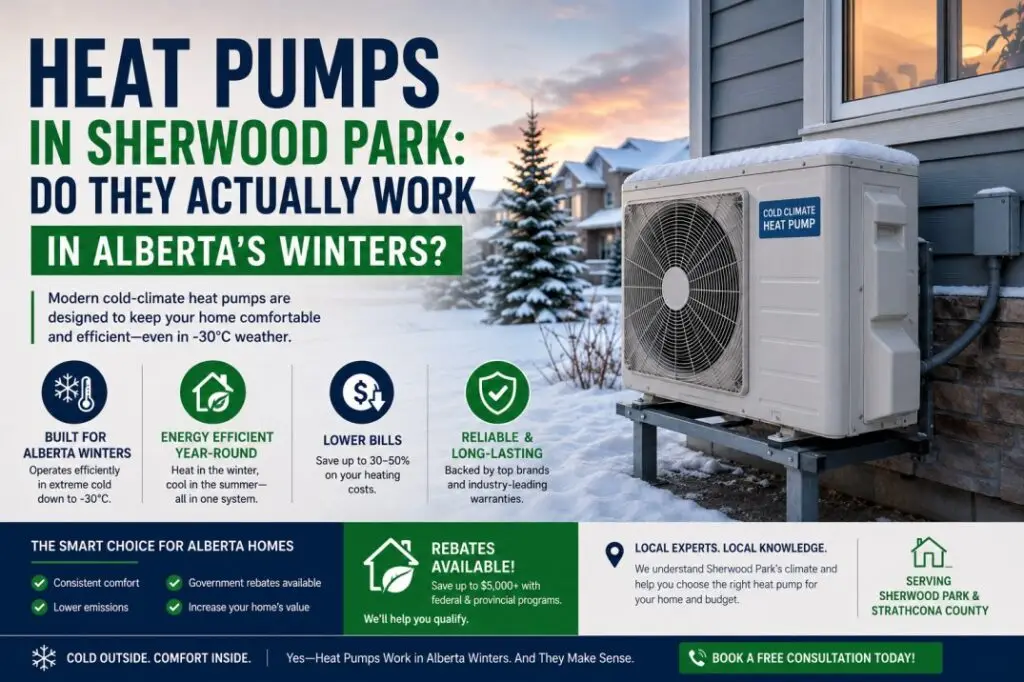
Heat Pumps in Sherwood Park: Do They Actually Work in Alberta’s Winters? Heat pumps have become one of the most discussed topics in Canadian HVAC over the past two years. Federal incentives, rising energy costs, and a national push toward electrification have driven a surge of interest — and a corresponding surge of confusion, particularly in Alberta where the climate is colder and the energy economics are different from most of the country. The honest answer to whether heat pumps work in Sherwood Park is more nuanced than either the enthusiasts or the sceptics suggest. They can work — and in the right configuration for the right home, they work very well. But several Alberta-specific factors determine whether a heat pump is the right fit for your specific situation — and this guide covers all of them. What Is a Heat Pump? (And How Is It Different from a Furnace or AC?) A heat pump is a single system that provides both heating and cooling by moving heat rather than generating it. In summer it extracts heat from inside your home and transfers it outside — cooling the space in the same way a central air conditioner in Sherwood Park does. In winter it reverses the process, extracting thermal energy from outdoor air and moving it inside to heat the home. This is the part that surprises most Sherwood Park homeowners: a heat pump extracts heat from outdoor air even when temperatures are well below freezing. There is measurable thermal energy in cold air — and a heat pump’s refrigerant cycle is designed to capture and transfer it efficiently. The critical efficiency metric is the Coefficient of Performance (COP) — the ratio of heat energy delivered to electrical energy consumed. A heat pump with a COP of 3 delivers three times as much heat energy as the electricity it uses to run. At moderate outdoor temperatures, heat pumps are dramatically more efficient than any resistance heating system. The complication — and the reason Alberta is a fundamentally different conversation than Vancouver — is what happens to COP as outdoor temperatures drop. The Alberta Cold Weather Problem: When Heat Pumps Struggle As outdoor temperature drops, the heat pump has to work harder to extract the same amount of thermal energy from increasingly cold air. Its COP decreases. At a certain outdoor temperature — the balance point — the heat pump’s efficiency advantage over a gas furnace disappears, and below that temperature, gas becomes both more effective and less expensive per unit of heat delivered. Modern cold-climate air-source heat pumps (ccASHPs) maintain rated heating output down to -25°C, with continued operation past -30°C at reduced capacity. This is a genuine improvement over older technology — the performance in Alberta winters is meaningfully better than what was available five years ago. But “continued operation at reduced capacity” is the phrase that matters most for Sherwood Park homeowners. On a -30°C night in January — not rare here — a standalone heat pump is working at reduced output. In these conditions, a backup heating source is not optional. This is why the hybrid dual-fuel configuration is the most practical approach for most Alberta homes. The Right Answer for Most Sherwood Park Homes: The Hybrid Dual-Fuel System The hybrid dual-fuel system pairs a heat pump with a gas furnace and a dual-fuel thermostat that automatically switches between the two based on outdoor temperature. When outdoor temperature is above the balance point — typically -10°C to -15°C — the heat pump runs and handles all heating demand efficiently. The gas furnace sits idle. When temperatures drop below the balance point, the thermostat automatically switches the heating load to the gas furnace, where the economics and performance are better. The result is a system that runs on electricity — the more efficient fuel source — for the majority of Alberta’s heating season, while retaining the cold-weather reliability of gas for Sherwood Park’s coldest stretches. For a homeowner with an existing furnace that is less than 10 years old and in good condition, adding a heat pump to the current setup is often the most cost-effective entry into hybrid heating. If your furnace is aging and approaching the replacement window, our furnace replacement service in Sherwood Park is the natural starting point — a new high-efficiency furnace paired with a heat pump is the most practical dual-fuel configuration. If financing a combined system is a consideration, that conversation should happen before selecting equipment so the total scope is factored into the decision. What About Full Electric Heat Pump Systems? A standalone heat pump without a gas furnace backup is viable for some Sherwood Park homes — but fewer than the marketing suggests. The case is strongest for homes replacing oil or propane heating (where the economics of switching to electricity are more favourable than switching from natural gas), very well-insulated new construction with a low heat loss rate, or homeowners whose primary motivation is reducing gas consumption. For the majority of Sherwood Park homes heated by natural gas with standard insulation, a standalone heat pump involves either electric resistance backup coils (highly inefficient in extreme cold) or a separate electric heating source — both of which are more expensive to operate per unit of heat than gas in Alberta’s current rate environment. Heat Pump Maintenance in Sherwood Park: What It Involves A heat pump used for both heating and cooling operates year-round rather than seasonally. This means more annual operating hours than a cooling-only system and maintenance requirements that reflect that. Annual professional heat pump maintenance in Sherwood Park should include: Refrigerant level check and leak inspection Indoor and outdoor coil cleaning — the same coil cleaning process included in our air conditioning maintenance service Electrical component testing — capacitors, contactors, and wiring connections Defrost cycle testing — heat pumps in heating mode periodically reverse to defrost the outdoor coil; this cycle must function correctly in Alberta’s sustained cold Airflow measurement across the indoor coil Dual-fuel thermostat