
Hot Water Tank Maintenance: A Practical Guide for Sherwood Park Homeowners
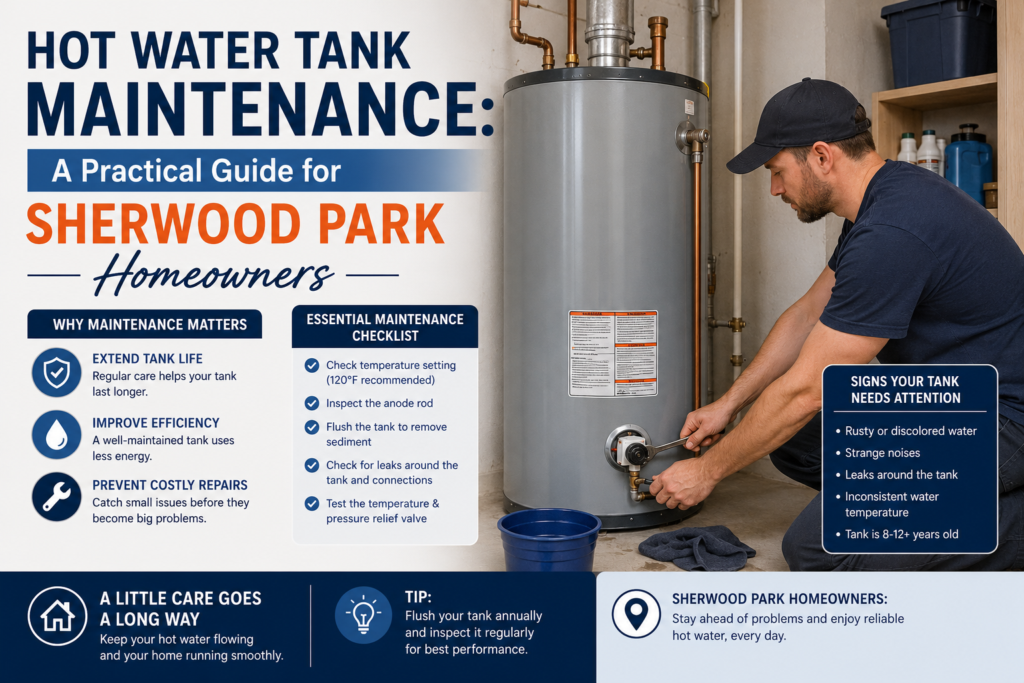
Hot Water Tank Maintenance: A Practical Guide for Sherwood Park Homeowners Most homeowners in Sherwood Park never think about their hot water tank until the morning they step into a cold shower. And by that point, the options are limited: emergency repair, emergency replacement, or an uncomfortable few days waiting for parts. The good news is that most hot water tank failures don’t happen without warning. They build up over months and years of mineral accumulation, anode rod depletion, and small issues that quietly progress until something gives way. A basic maintenance routine — combined with knowing what to watch for — extends your tank’s lifespan significantly and gives you time to plan replacement before it becomes an emergency. This guide covers what maintenance your hot water tank actually needs, how often, and what the signs of a system approaching failure look like. Understanding Your Hot Water Tank Before maintaining something, it helps to understand how it works. A conventional hot water tank stores a fixed volume of water — typically 40 to 60 gallons — and maintains it at a set temperature using either a gas burner (most common in Sherwood Park homes) or an electric heating element. When you draw hot water, cold water enters the tank at the bottom and is heated to replace it. Two components are critical to the tank’s longevity and deserve particular attention: The anode rod is a sacrificial metal rod — usually magnesium or aluminum — suspended inside the tank. Its entire purpose is to corrode. By attracting the corrosive elements in the water to itself, it protects the tank’s steel lining from rusting. When the anode rod is fully depleted, the tank itself becomes the corrosion target. Most hot water tank failures in Alberta trace back, one way or another, to a depleted anode rod that was never inspected or replaced. The pressure relief valve (TPR valve) is a safety device that releases pressure if the tank exceeds safe operating temperature or pressure limits. It is not a maintenance item in the traditional sense, but it should be tested annually to confirm it opens and closes freely — a stuck TPR valve is a safety hazard. The Annual Maintenance Checklist 1. Flush the tank (every 6–12 months) Sherwood Park’s hard water causes mineral sediment to accumulate at the bottom of the tank over time. This sediment insulates the bottom of the tank from the burner heat, forcing the burner to run longer and hotter to heat the water above. You will often hear a rumbling, popping, or kettling sound from a tank with significant sediment buildup — that sound is the heating element burning through the scale deposits. Flushing the tank removes the accumulated sediment. The process involves: Connecting a garden hose to the drain valve at the base of the tank Shutting off the cold water supply to the tank Opening the drain valve and allowing the tank to drain until the water runs clear Closing the drain valve, removing the hose, and restoring water supply On an older tank that has never been flushed, the drain valve itself may be stiff, clogged, or prone to leaking after being opened for the first time. If you have any doubt about your ability to close the valve properly after flushing, this is a job for a technician. 2. Inspect and replace the anode rod (every 3–5 years) The anode rod is accessed through the top of the tank — typically under or near the cold water inlet. Inspecting it involves removing it with a socket wrench and checking its condition: a rod that has been reduced to less than half its original thickness, or that is heavily coated in calcium deposits, should be replaced. In Sherwood Park’s hard water environment, anode rods tend to deplete faster than in softer water areas. Inspecting every three years — rather than the standard five — is a sensible approach for most homes here. This is not a difficult job for a mechanically inclined homeowner, but it does require shutting off the cold water supply and partially draining the tank. If you are not confident in the process, a licensed plumber or HVAC technician can inspect and replace the anode rod during a service call. 3. Test the pressure relief valve (annually) The TPR valve is typically located near the top of the tank with a small lever handle. Testing it involves lifting the lever briefly to allow a small amount of water to discharge through the relief tube, then releasing it. The valve should snap shut cleanly with no continued dripping. If the valve continues to drip after testing, leaks around the body, or does not open at all, it should be replaced. A faulty TPR valve is not something to defer — it is a primary safety device. 4. Check the temperature setting (annually) Your water heater’s thermostat should be set to approximately 49°C (120°F). This is the recommended setting that balances safety (avoiding scalding), energy efficiency, and legionella prevention in the tank. Higher settings waste energy by keeping water hotter than necessary. Lower settings create a risk of bacterial growth in the stored water. Check the setting annually and adjust if it has drifted. 5. Inspect all connections for leaks (annually) With the tank under pressure, inspect the cold water inlet, hot water outlet, TPR valve discharge pipe, and gas connections (for gas units) for any signs of moisture, corrosion, or mineral buildup. Small drips often go unnoticed for months before they become significant leaks. Warning Signs That Need Immediate Attention These are the symptoms that mean call a technician promptly — not something to monitor and hope resolves itself: Rust-coloured or discoloured water from hot taps. This is typically a sign that the anode rod is depleted and the tank lining has begun to corrode. Once the tank is corroding internally, the end of its useful life is close. If the discolouration appears in cold water as well, the issue
Tankless Water Heater vs Hot Water Tank: Which Is Right for Your Sherwood Park Home?
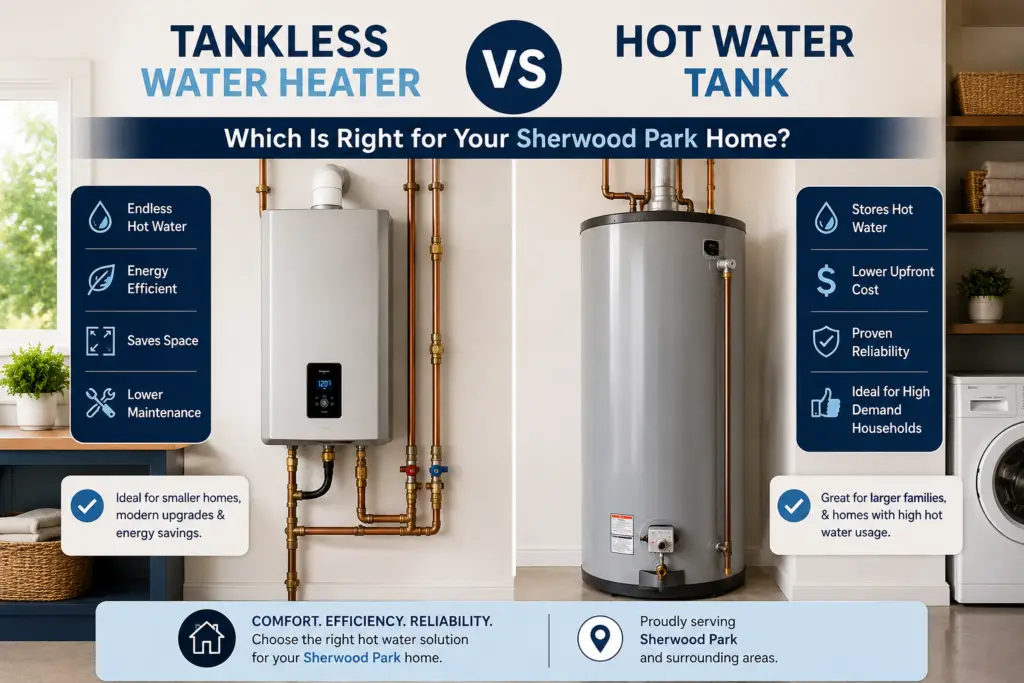
Tankless Water Heater vs Hot Water Tank: Which Is Right for Your Sherwood Park Home? Every Sherwood Park homeowner will face this decision eventually: when the current water heating system reaches the end of its life, do you replace it with another traditional hot water tank, or make the switch to a tankless system? It’s not a straightforward answer — and anyone who tells you one option is always better than the other isn’t giving you the full picture. The right choice depends on your household size, how you use hot water, the age of your home’s gas lines and venting, and — critically — the quality of water in your area. This guide walks through everything that actually matters for Sherwood Park homeowners making this decision. How Each System Works Before comparing them, it’s worth understanding the fundamental difference in how these two systems operate. Traditional hot water tanks store a fixed volume of water — typically 40 to 60 gallons — and keep it heated continuously, 24 hours a day, whether you are using it or not. When you turn on the hot water tap, heated water flows from the tank, and cold water enters at the bottom to be reheated. Once the tank runs out of stored hot water, you wait for it to recover. Tankless water heaters work on a completely different principle. They have no storage tank. When you turn on a hot tap, cold water passes through a heat exchanger inside the unit, which uses either a gas burner or electric element to raise the water temperature on demand. The moment you close the tap, the unit shuts off completely. You get hot water only when you need it, and theoretically you can never run out. Understanding this difference explains most of what follows. Lifespan: A Significant Difference This is one of the clearest points of comparison between the two systems. A traditional hot water tank in Alberta typically lasts between 8 and 12 years. The limiting factor is almost always corrosion — the tank is constantly storing water, and over time, the anode rod (which is designed to attract corrosive minerals) depletes. Once it does, the tank itself begins to corrode from the inside, leading to rust-coloured water and eventually a leak. A well-maintained tankless water heater typically lasts between 20 and 25 years — roughly double the lifespan of a tank. Because there is no storage vessel constantly exposed to water, there is no equivalent corrosion mechanism. The components that do wear (the heat exchanger, the burner assembly, the water inlet filter) are generally serviceable and replaceable individually, rather than requiring replacement of the entire unit. For Sherwood Park homeowners planning to stay in their home long-term, this lifespan difference is meaningful. Alberta’s Hard Water Problem: What It Means for Both Systems This is the factor that most generic tankless vs tank comparisons skip — and it matters significantly in Sherwood Park and the wider Strathcona County area. Alberta’s water supply is notoriously hard, meaning it carries a high concentration of dissolved calcium and magnesium minerals. When water is heated, these minerals precipitate out and form scale — a hard, chalky deposit that accumulates over time inside heating components. In traditional hot water tanks, scale settles at the bottom of the tank and around the heating element. You will often hear a rumbling, popping sound from a tank with significant sediment buildup — that’s the heating element burning through the scale deposits every cycle. This buildup reduces efficiency and accelerates the timeline to tank failure. In tankless water heaters, scale accumulates inside the heat exchanger — a much more compact and sensitive component. If a tankless unit is not descaled regularly in a hard water area like Sherwood Park, the heat exchanger can become restricted, reducing flow rate and efficiency, and ultimately causing the unit to fail prematurely. The key difference is what regular maintenance looks like: For a traditional tank, annual maintenance involves flushing sediment from the bottom of the tank — a relatively quick and straightforward process. For a tankless unit, annual maintenance requires professional descaling using a purpose-built flush kit and descaling solution circulated through the heat exchanger. This is not a DIY job, and skipping it in Alberta’s hard water conditions is one of the most common reasons tankless systems fail well before their expected lifespan. The practical implication: a tankless water heater in Sherwood Park that receives annual descaling will outlast almost any tank and perform reliably for two decades. A tankless unit that is installed and ignored will likely start causing problems within five to eight years, at which point it has not delivered the value it promised. Performance: Endless Hot Water vs Guaranteed Supply For most households, the real-world performance difference comes down to one question: how many people are using hot water simultaneously? Traditional hot water tanks provide a guaranteed supply of hot water up to the tank’s capacity. A family of four running two showers, a dishwasher, and a laundry load simultaneously will draw on the same reservoir. Once the tank’s stored volume is depleted, everyone waits for recovery — which can take 30 to 45 minutes on a standard unit. Tankless water heaters eliminate the recovery wait entirely. However, they have a different limitation: flow rate. A tankless unit can only heat water at a certain number of gallons per minute — and that flow rate is reduced when incoming water is very cold, which is exactly what happens during Alberta winters. The incoming water temperature in Sherwood Park during January can be as low as 4°C, which means the unit has to work harder to reach your desired output temperature, reducing the flow rate it can sustain. For a household of two to three people with standard hot water usage patterns, a properly sized tankless unit handles everything without issue. For a large household running multiple high-demand fixtures simultaneously — particularly in winter — proper sizing becomes critical, and in