
Signs Your Air Conditioner Needs Replacing (Not Just Repairs)
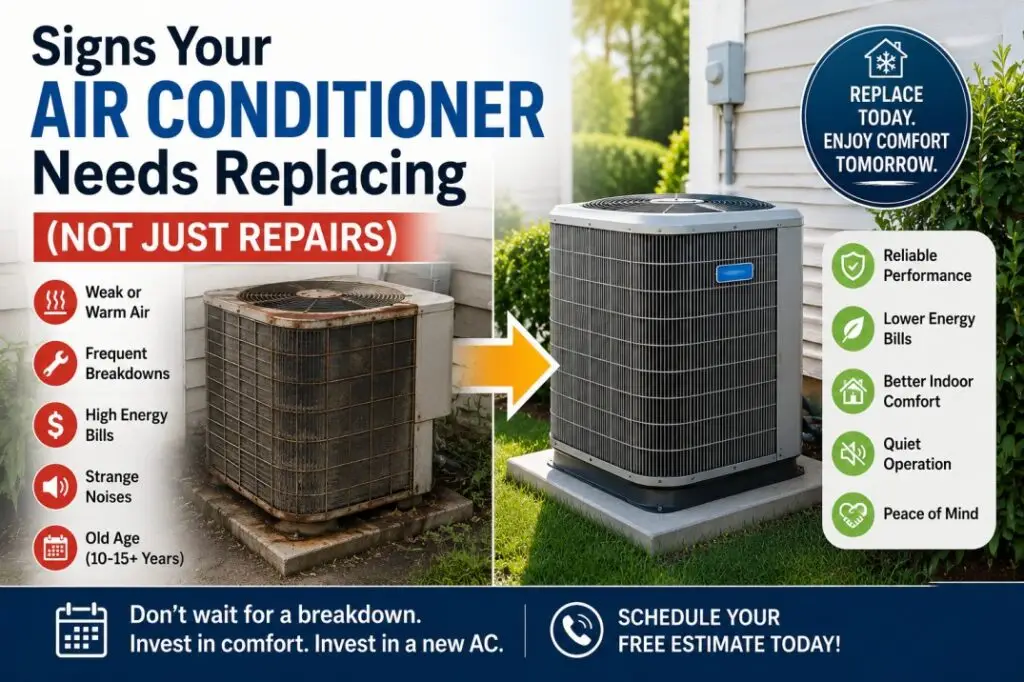
Signs Your Air Conditioner Needs Replacing (Not Just Repairs) When your air conditioner stops working the way it should, the first question is always the same: Is this something that can be fixed, or is it time for a new system? It’s not always an easy call. Repair costs are immediate and known. Replacement feels like a bigger commitment. But continuing to repair an AC system that has fundamentally reached the end of its useful life costs more in the long run — through repeated service calls, rising energy consumption, and the inevitable emergency failure on the hottest weekend of the summer. This guide walks you through the clearest signs that your air conditioner is telling you it’s ready to be replaced — so you can make an informed decision rather than an emotional one. How Long Should an Air Conditioner Last? Understanding the typical lifespan of an AC system is the starting point for any repair vs. replace decision. A well-maintained central air conditioner in Alberta typically lasts between 12 and 15 years. Systems that have been serviced consistently every year, with filters changed regularly and coils kept clean, tend to reach the upper end of that range. Systems that have been neglected — run without annual service, filters left unchanged for months, minor issues ignored — often begin to decline noticeably after 8 to 10 years. If your system is under 10 years old and experiencing problems, repair is almost always the right answer. If it’s over 10, the calculus shifts significantly toward replacement — particularly when multiple components are failing at the same time, or the type of refrigerant your system uses. 7 Signs Your AC Needs Replacing 1. The System Is Over 12 Years Old and Requires Frequent Repairs Age alone isn’t necessarily a reason to replace an AC — but age combined with a recent pattern of increasing repairs is a strong signal. If you’ve called for service two or three times in the past two summers, you’re likely approaching a tipping point where the compressor or another major component is next to go. When an older system starts requiring service repeatedly within a short window, the individual repairs may look manageable — but the cumulative spend adds up quickly. A licensed technician can give you an honest assessment of what the system’s major components look like and whether continued repair is a realistic strategy or a temporary delay of the inevitable. 2. Your Home Isn’t Cooling Evenly Anymore A well-functioning air conditioner maintains consistent temperatures throughout your home. When you start noticing that certain rooms never quite reach a comfortable temperature, or that there’s a significant difference between how the main floor and upper floor feel, the system may no longer have enough capacity to do its job. Uneven cooling can sometimes be addressed through ductwork adjustments or airflow balancing — but when it appears in an older system alongside other symptoms, it often signals that the system is losing its ability to perform at its rated capacity. Compressor wear, refrigerant issues, and degraded internal components all contribute to this gradual loss of performance. 3. The System Uses R-22 Refrigerant If your air conditioner was installed before 2010, there’s a good chance it uses R-22 refrigerant — a substance that has been phased out across Canada due to its environmental impact. R-22 is no longer manufactured, making it increasingly difficult and expensive to obtain. If your older system develops a refrigerant leak and requires a top-up, the unavailability of R-22 can make a repair impractical, regardless of the condition of other components. Ask your technician which refrigerant your system uses — if it’s R-22, that information should factor significantly into your replacement planning. 4. Your Energy Bills Have Increased Without Explanation Air conditioners lose efficiency as they age. Components wear, coils accumulate buildup, and the system has to run longer to achieve the same result it once reached easily. This gradual decline shows up on your energy bills — not as a sudden spike, but as a creeping increase that becomes noticeable when you compare this summer’s bills to bills from three or four summers ago. If your home’s usage patterns haven’t changed significantly but your energy consumption during cooling season has increased noticeably, your AC’s declining efficiency is a likely contributor. Modern systems are substantially more efficient than equipment from 10 to 15 years ago, and the efficiency gain from a new system can be significant over the long run. 5. The Compressor Is Failing The compressor is the heart of your air conditioning system — it’s the component that pressurizes the refrigerant and drives the entire cooling cycle. It is also the most expensive component in the system to replace. Signs of compressor trouble include hard starting (the system struggles to come on), the system running constantly without adequately cooling the home, loud clanking or rumbling sounds from the outdoor unit, or the system tripping the circuit breaker repeatedly. When a compressor fails on an older system, the repair estimate often approaches or exceeds the value of replacing the entire unit with a new, efficient system. If your technician tells you the compressor needs replacing on a system that’s already 10 years or older, replacement is almost always the more sensible long-term decision. 6. Refrigerant Leaks Keep Recurring Refrigerant doesn’t deplete under normal circumstances. If your system has needed refrigerant top-ups more than once, it has a leak — and if that leak keeps recurring after repairs, the integrity of the system’s refrigerant lines is compromised. Ongoing refrigerant loss damages the compressor, reduces cooling performance, and adds recurring service costs without resolving the underlying problem. A single refrigerant leak in a system that’s otherwise healthy and relatively young is typically worth repairing. Recurring leaks in an older system, or a leak in a difficult-to-access location within an aging unit, are strong indicators that a full air conditioning replacement is the more sound approach. 7. The System Makes Noises It Never Used